Behind the change of chairman of Jiaxing Bank: the growth rate of net profit for three consecutive years was negative, and internal control loopholes were frequently exposed.


Many people have worked hard for most of their lives just to buy a house of their own and live a comfortable life with their families. After buying a house, decoration naturally becomes the most important thing.
But in the face of decoration, many people are puzzled, especially in the choice of decoration companies and construction teams, there will be some misunderstandings more or less. Not only did you spend money in vain, but you also made a lot of anger. Recently, Mr. Wen, who lives in Haowangling, Dongke, encountered such a troublesome thing.
Two expenses for buying a house in renovation contract. The salesman said it was a sum.
The 44-year-old Mr. Wen is a member of the three religions. A year ago, he bought a new house in the city to facilitate his children to attend primary school. Since I was working in a foreign country, I left the home decoration to my wife.
"At that time, there were many decoration companies engaged in activities in the community. When they saw the right price and integration, they signed the contract." Mr. Wen said that there is also a fellow villager of the three religions who bought a house with him. After several comparisons, both of them took a fancy to a design company named "Youshao Architectural Decoration".
Under the introduction of the staff, they learned that this decoration company has just opened and is launching a series of preferential activities. It only needs to pay more than 60,000 yuan to get the design and decoration together, and the rest will not be charged any fees. Considering that the children should be renovated as soon as possible after school starts, Mr. Wen’s wife immediately signed the contract.
Mr. Wen said that when his wife signed the contract, she noticed that there were two expenses on it, one was the decoration fee and the other was the design fee, both of which were 66,300 yuan. "Not to say that just pay a sum of money is enough? How come there are two more here? " After asking questions, the salesman explained that this was actually an expense.
At that time, because all aspects were suitable, Mr. Wen’s wife signed the contract without much concern.
There are many problems
The actual decoration is different from the salesman’s promise.
After the contract was signed, the decoration company began to arrange the construction team to carry out the decoration. During this period, Mr. Wen paid the first two payments twice, and the remaining 20,000 pieces were delivered after acceptance.
"I went home several times on the way, either there is a problem here or there is a problem." Mr. Wen said that during the renovation of the workers, he and his wife visited the house several times and found that there was a certain discrepancy with the situation promised by the salesman at that time. "The five-in-one latex paint has become two-in-one, and the good brand door has no trademark, and the wrapping material on the wall has also changed from solid wood to PVC."
After several tests, Mr. Wen felt more and more wrong. Why is it completely different from what he said at the beginning? He went to the salesman to ask for an explanation, but the other party was always vague, just saying that it was really impossible to refund the difference.
"The boards in the wardrobe are all broken, and it is definitely not solved by returning the difference or changing the board." Mr. Wen said that the contract did not specify the commencement and completion time. Originally, it was promised that it would be completed within July. However, due to the contradiction in the decoration, the problem was delayed again and again. Seeing that the child is about to start school, he is also very anxious. "I suspect this is a scam."
Contradictory accumulation
The decoration company now takes consumers to court.
Mr. Wen, who felt cheated, became more and more angry, and made it clear to the decoration company that if the problem could not be solved, the remaining 20 thousand yuan would not be paid. As a result, the contradictions between the two sides have deepened.
In September last year, Mr. Wen thought that his children were about to start school, and his portable family moved to a new house. Unexpectedly, this move has been regarded as qualified in the contract.
"The baby wants to study, what if I don’t live in?" Mr. Wen said that at that time, he asked the other party to rent a place for himself temporarily, and after solving the decoration problem, he paid off the balance, but this request was rejected by the other party. In desperation, he had to bite the bullet and live in.
This end of the decoration is not satisfied, and the other end is urging the final payment. The problem has not been solved again and again, and the delay is half a year. Not long ago, the decoration company took Mr. Wen to court on the grounds that he did not pay the final payment. But the most puzzling thing came. In the lawsuit received, Mr. Wen’s unpaid balance of 20,000 yuan turned out to be more than 90,000 yuan.
"At that time, when I asked, I said it was a sum, and now I say that the two expenses as above are separate." Mr. Wen said that because the salesman who signed the contract for himself at that time had left his job, the statement given by the company was very different from that at that time, and the agreed fee became two.
embarrassing incidents
The salesman said that the two parties misunderstood the two payments.
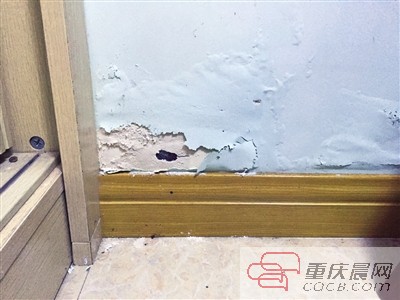
"Everything must be honest, and we must never let it go." Regarding the company’s lawsuit, Mr. Wen said that it has only been less than half a year since he moved in, and the house has already started to have problems such as paint peeling, foaming, and poor wardrobe closure. He had the same experience as Ms. Xiang, a fellow villager who signed the contract together at that time.
Afterwards, the reporter contacted Mr. You, the salesman who signed the contract at that time. Regarding Mr. Wen’s doubts in the renovation process, he said that when the other party was dissatisfied with the renovation results, the company also indicated that it was willing to replace some furniture parts, but the other party asked for all the new ones. The company failed to agree, and the two sides have been deadlocked until today.
"At that time, the company just opened and its management was not perfect." Mr. You said that the terms of the contract were all formulated by the company’s special personnel, and he was not particularly clear about the payment. When signing the contract, both parties misunderstood the above two sums, which caused this "Oolong" incident. But from the understanding level at that time, the two expenses on the contract were actually one.
In this regard, the reporter also called the person in charge of the decoration company, Mr. Zhang. The other party explained that because the salesman was no longer in the company at that time, the company was not clear about the negotiation process when the two sides signed the contract. As for the payment and acceptance, the company only follows the contract. At present, the judicial process is already in progress, and all the results have to wait for the court’s ruling.
Lawyer’s statement >
Confirm every detail of the contract before signing it
In the summer, Chongqing Xueyuan Law Firm suggested that when signing a contract with a decoration company, citizens must read and understand each clause carefully, especially the part involving the payment and the total delivery price. If they don’t understand it, they must confirm it with the relevant person in charge before signing it, so as to avoid unnecessary contradictions caused by the contents of the contract in the future and protect their legitimate rights and interests.
Zhongxin. com, Chengdu, September 6 (Liu Zhongjun, Gao Hengrui) On September 6, the State Grid Sichuan Electric Power Company revealed that emergency personnel carrying generators, gasoline and other emergency materials had arrived at the temporary resettlement sites of people in Wanggangping Township, Shimian County, Ya ‘an City, located in the Dadu River Gorge, and connected emergency electricity to the resettlement sites.
On September 5, an earthquake of magnitude 6.8 occurred in Luding County, Ganzi Prefecture, Sichuan Province, and an earthquake of magnitude 4.2 occurred in Shimian County, Ya ‘an City. After the earthquake, State Grid Sichuan Electric Power Company urgently deployed its subordinate State Grid Leshan, Zigong, Meishan and Deyang power supply companies, Sichuan Electric Power Emergency Center, EHV Company and power transmission and transformation company to carry emergency materials and equipment such as electric generators, generators and lighting lamps to the earthquake area to support power rescue.
By 13: 00 on the 6th, two 110kV substations, two 35kV substations, one 500kV line, three 110kV lines, two 35kV lines and twenty-seven 10kV lines had been restored after emergency repair by emergency rescue personnel. 22,340 households have resumed power supply.
Due to the interruption of road traffic caused by the earthquake, Wanggangping Township, Shimian County, Ya ‘an City, which is located in the Dadu River Gorge, has become an "isolated island after the earthquake". At 13: 20 on the 6th, the Communist party member Service Team of Sichuan Electric Power (Ya ‘an Hanyuan) of the State Grid advanced to Wanggangping by water, and set out by boat from Xinmin Township Temporary Wharf with three generators, 300 liters of gasoline, 3,000m conductor and hundreds of switches. At present, the assault team has arrived in Wanggangping, and is fully engaged in the investigation of hidden dangers of equipment and facilities, power emergency recovery and other work.
At present, State Grid Sichuan Electric Power has completed the preparation of the emergency repair plan for three main transformers at the 500 kV asbestos station, and carried out flying patrol work for 500 kV Dajiang No.1 and No.2 lines, Kangshu No.4 circuits and 110 kV Xiada lines, Caoda lines, etc. At the same time, it actively carried out the safety inspection and publicity of electricity use at the site headquarters and the resettlement sites for the affected people, and carried out convenience services to ensure the safety of electricity use.
State Grid Sichuan Electric Power Co., Ltd. said that the next step will be to continue to strengthen communication with local government emergency, earthquake, letter and energy departments, do a good job in power supply protection in emergency headquarters and centralized resettlement sites, comprehensively investigate equipment hidden dangers, coordinate emergency repair resources in various ways, and do a solid job in power supply protection and earthquake relief.
Chongqing morning post, September 17 th, "Is there any softness?" Recently, on a flight from Nanning to Chongqing, Jin Sheng (a pseudonym), a passenger who flew for the first time, walked into the bathroom during the flight, took a shower with a washbasin punch, and "occupied" the bathroom for half an hour. After being discovered by the flight attendant, he even reached out and asked for shampoo. Finally, the airline gave him an oral education.
The bathroom was closed for half an hour.
"Miss, do you see if there is something wrong with the passengers here?" On the plane, the first suspect was a middle-aged female passenger. Shortly after the plane took off, a man got into the bathroom and never came out. Because the man "occupied" the bathroom for nearly half an hour, the passengers had to queue up to go to another bathroom.
Semi-naked men ask stewardesses to be soft.
The passengers called a stewardess. The stewardess knocked on the door politely. "Is there anything wrong with the passengers inside?" Didn’t hear a response.
"Look, there is water coming out of it." The eagle-eyed passenger suddenly found that water was slowly oozing from the door below.
The stewardess kept knocking at the door, but there was still no response. A few minutes later, the stewardess was ready to take emergency measures to open the door with the key. At this point, the passengers inside opened the door.
As you can see, a tall and thin man of about 30 years old is naked, with his head and body wet. The stewardess also found that the whole bathroom had been made a mess, and the walls on the ground were covered with water stains.
What makes people laugh and cry is that at the sight of the stewardess standing at the door, the man stretched out a wet right hand and asked, "Miss, are you soft?" I want to wash my hair. "
Wage earners seldom take hot baths.
It turned out that the man’s name was Jin Sheng, a Chongqing native who worked in Shenzhen. Because the discount on air tickets is relatively low, when he returned to Chongqing this time, he flew to open a "foreign meat". The first time I flew by plane, Jin Sheng felt everything was fresh: "I was going to the toilet, but as a result, there was still hot water in the faucet." I just want to take a bath by the way. "
Because of the poor working and living conditions, Jin Sheng usually takes a bath for more than a week, and he has to boil hot water himself. He took off his clothes and washed it well.
"I saw that there were drinks and meals on the plane. I want to take a bath and there should be Rejoice shampoo." Therefore, it was found that after taking a bath, Jin Sheng confidently asked the stewardess for shampoo.
The passengers accused him of disregarding public morality.
Other passengers on the plane condemned Jin Sheng’s behavior. The first suspicious middle-aged woman said, "There are only two bathrooms, so you can’t take one." Other passengers also blamed him for soiling the bathroom.
For such a problem, airlines don’t know how to deal with it. In fact, the relevant aviation regulations do not prohibit passengers from taking a bath in the bathroom on the plane. After the plane arrived in Chongqing, the airline staff could only give Jin Sheng an oral public morality education.
A person in charge of the airline said in an interview: "The plane has become a public transport. However, the quality and public morality of passengers are not as popular as flying. "
Editor: Li Dan
Original China Cooking Magazine China Cooking Magazine
The combination of cultural tourism and catering is an excellent means to attract tourists from all over the world in recent years. The distinctive representative food is no less attractive to "gourmets" than the beautiful scenery and human landscape. It is not uncommon for people to run around on social networking sites in order to "eat a bite". Counting the "online celebrity cities" in recent years, no matter Xi ‘an, Luoyang, Harbin, or Zibo, Kaili, Lanzhou ….. without exception, they all have the strong blessing of special food.
Today, we bring a group of seasonal dishes from popular tourist cities. Delicious and characteristic blend in one dish, allowing you to cross geography and taste mountains and rivers in one bite.
Where did you punch in your food map? Come and leave a message to share with us, and the wonderful answer will be won in the May 2024 issue of Cooking in China!
New-style flower-exploring crispy peach blossom is pan-spreading.
Text/Chu Hong Yan Shi Ye Xintu/Zhang Yang
Planning/Production by Wang Peixin/Hao Chunjie
Food supply/Cuihua Building, Beijing
This is an upgraded version of the traditional famous dish Taohuapan. Compared with the "classic version", the shape and materials have changed greatly. The addition of fresh peach blossoms makes the peach blossoms famous, and the shape of the honeycomb has changed from the loose presentation in the past. The design of seafood wrapped inside makes the whole dish look like a cascade of flowers, bringing many surprises.

raw material
Scallop, shrimp, dried noodles, rice, fresh peach blossom, lime peel, peach blossom powder, salt, olive oil, butter and homemade sweet and sour sauce.
preparation
Clean scallops and shrimps, marinate with salt and olive oil for 15 minutes, slowly cook for 20 minutes at low temperature under vacuum until it is 70% cooked, pat with the back of a knife, cut into small pieces and mix well; Boil fresh peach blossoms with water, mix them with dried noodles and peach blossom powder, add butter to make batter, and wrap them with shrimp stuffing to make peach blossom buns; Heat the hot oil from the pot to 160℃ to 170℃, slowly put in the peach blossom buns, keep the oil temperature so that the surface of the peach blossom buns is honeycomb, and take out and drain the oil; Dry the rice into a crystal rice crust, put it on the bottom of the plate, put the fried peach blossom bag on the rice crust, rub a little lime peel, and pour the homemade sweet and sour sauce on the table.
Chef tips
The preparation method of sweet and sour sauce: mix tomato sauce, sliced sugar, preserved plum, dried tangerine peel powder, apple vinegar and white vinegar, and thicken.
Xishuangbanna air-dried Koharu chicken
Text/Chu Hongtu/Zhang Yang
Planning/Made by Zhao Yibin/Zhang Huning
Dishes provided/Beijing Puyun Yunnan Cuisine
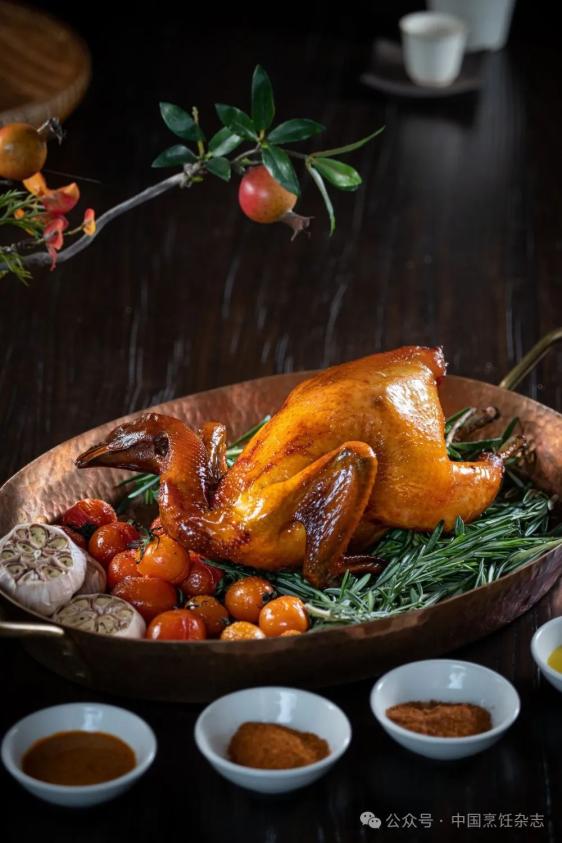
The reappearance of Xishuangbanna style barbecue, the chicken is crispy outside and fragrant inside, with the local common roasted garlic, western-style rosemary adds fresh flavor.

raw material
Spring chicken, roasted garlic, roasted tomato, rosemary, sweet noodle sauce, yellow mustard sauce, dry ingredients, fig leaves, Amomum tsaoko, fragrant leaves, star anise, onion, ginger, salt and syrup.
preparation
Clean the spring chicken, evenly rub the chicken body with fig leaves, onion, ginger, Amomum tsaoko, star anise, fragrant leaves and salt, marinate, rinse, hang slurry water, air dry for 1 day, bake in the oven at 200℃ for about 40 minutes, and take out; Burn rosemary with fire, pad the bottom of the plate, put the roasted garlic and tomato on the edge of the plate, put the roasted Koharu chicken on it, and serve it with sweet noodle sauce, yellow mustard sauce and two kinds of dry ingredients.
Chef tips
The formula of two kinds of dry materials: one is sesame seeds, peanuts, tsaoko powder and salt, and the other is the above formula with Chili noodles.
Night fragrant flower egg roll
Text/Chen Litu/Peng Jianheng
Food supply/Guangzhou Golden Restaurant
Night fragrant flowers are also called night orchids, and there is a delicious flower on the dining table, which brings an atmosphere full of spring. It is difficult to store and transport the night fragrant flowers after they are in full bloom, so the food supplier will pick them when the buds just open and make them into chilled night fragrant flowers, which is convenient and fast. Elegant night fragrant flowers are green in color, especially refreshing. You can fry eggs, and then spend some time rolling them up, which is the "online celebrity dish" that everyone loves.

raw material
Night fragrant flowers, carrots, eggs, salt, chicken powder, pepper.
preparation
Thawing chilled Nostoc fragrans, drying, and planing carrot into filaments for later use; Separate the egg white and yolk, break them separately, add salt, chicken powder and pepper to taste, add night fragrant flowers to the egg yolk and mix well, and add shredded carrots to the egg white and mix well; Fry the two kinds of egg liquid into egg cakes respectively, stack them, roll them, cut them into pieces and put them on a plate.
Production key
When it is made, it can be directly rolled in a jade pot; The color of the egg cake can be changed by different superposition methods, usually because the yolk part is refreshing, and the taste is better when placed on the outer layer.
Sauté ed bamboo shoots with pickled vegetables
Text/Chu Hongtu/Zhang Yang
Planning/Wang Min Production/He Lingzi
Food supply/Beijing Xiang Lin Tian Xia
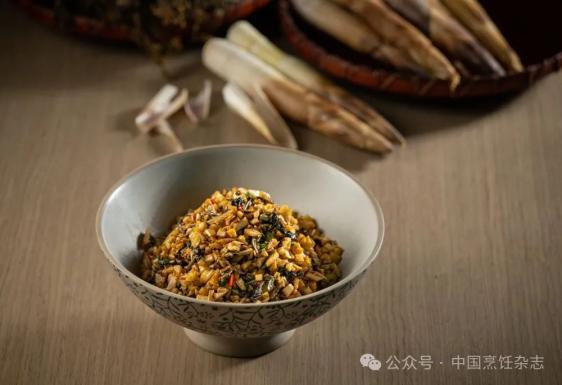
In November and December every year, white cabbage sprouts are abundant in Hunan. People can make pickled vegetables by drying them in the sun, which will produce special fragrance. In the spring of next year, these pickled vegetables will become the best partners of bamboo shoots, and together they will perform the crispy, delicious, spicy and attractive Xiangtan specialty dishes.

raw material
Hunan small bamboo shoots, Hunan pickles, Liuyang red chicken intestines pepper pieces, garlic sprouts, lard, Xiangtan soy sauce, salt, monosodium glutamate.
preparation
Breaking bamboo shoots, shelling, chopping and blanching for later use; Soak pickles in clear water, wash them, chop them up, blanch them and fry them dry for later use; Add lard and salt to the pan, stir-fry chopped bamboo shoots, pickles and peppers, add soy sauce and color, add a little water, add salt and monosodium glutamate to taste, sprinkle a little garlic sprouts, collect juice over high fire, and take out the pan and plate.
Production key
Do not add water to stir-fry in the early stage, but stir-fry the bamboo shoots with soy sauce until they are colored and fragrant.
Editor | Shi Yexin
Proofreading | Yujin
The content of this article is selected from the April 2024 issue of China Cooking Magazine. Welcome to forward it to your circle of friends. All the contents of this micro-signal are unauthorized, and it is refused to be reproduced. Infringement will be investigated. If you need to reprint, please contact the backstage and get authorization before reprinting. Please indicate the source and author’s signature in a prominent position when reprinting.
More exciting content
Click on the cover below to buy.
Click on the link below
See more special recipes
Pork ribs | beef | mutton chicken 1 | chicken 2 | chicken soup crayfish | braised pork | vinegar dish | vegetarian soup


Continue to slide to see the next touch to read the original text.

China cooking magazine slides up to see the next one.
Original title: "online celebrity City Delicious New"
Read the original text

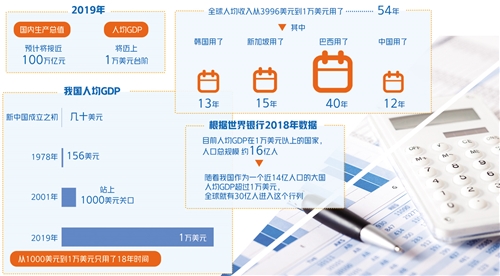
In 2019, China’s per capita GDP is expected to reach $10,000. As a big country with a population of nearly 1.4 billion, this achievement is hard-won, which fully demonstrates the strong driving force and great potential of China’s economic development. At the same time, it also means that the scale of middle-income groups in China is further expanded, which is helpful to cultivate new economic growth points, promote China’s economy to a domestic demand-driven growth model, and enhance its ability to resist external shocks — —
This month, the National Bureau of Statistics will officially announce the transcripts of the national economy in 2019. The annual GDP is expected to be close to 100 trillion yuan, and the per capita GDP will reach 10,000 US dollars.
As the largest developing country in the world and the second largest economy in the world, China’s per capita GDP has exceeded $10,000. What does it mean for China’s economy and the world economy? What a remarkable achievement is this?
Highlight a stronger comprehensive national strength
"The improvement of this economic scale not only means that people’s income has increased and their lives have become more affluent, but also is a major progress in human history." Ning Ji Zhe, deputy director of the National Development and Reform Commission and director of the National Bureau of Statistics, said that according to the data of the World Bank in 2018, the total population of countries with per capita GDP above 10,000 US dollars is about 1.6 billion. As China, as a big country with a population of nearly 1.4 billion, has a per capita GDP of more than 10,000 US dollars, 3 billion people in the world have entered this ranks, which will undoubtedly have a positive impact on the world.
"According to the World Bank’s middle income standard (per capita income of $3,996 to $12,375), it took 54 years for the global per capita income to reach $10,000. Among them, it took 13 years for South Korea, 15 years for Singapore, 40 years for Brazil and 12 years for China. " Xin li, a professor at the School of Statistics of Beijing Normal University, said that China’s population base is significantly higher than that of other middle-income countries, and it is really hard to achieve a higher per capita income level and more inclusive economic growth (poverty reduction) in a shorter period of time under the situation of weak economic foundation and complicated internal and external environment.
Li Zuojun, deputy director of the Institute of Resources and Environmental Policy of the State Council Development Research Center, said that at the beginning of the founding of New China, China’s per capita GDP was only a few tens of dollars. In 1978, the per capita GDP was only $156, and it was not until 2001 that it reached the $1,000 mark. It took only 18 years from $1,000 to $10,000, which is enough to show the strong power and great potential of China’s economic development.
"Although China’s per capita GDP still belongs to ‘ Intermediate students ’ However, as the country with the largest population in the world, the per capita GDP exceeding 10,000 US dollars clearly demonstrates China’s strong comprehensive national strength. " Li Zuojun said.
Xu Hongcai, deputy director of the Economic Policy Committee of the China Policy Science Research Association, said that after China’s per capita GDP exceeded 10,000 US dollars, it was another step forward from the ranks of high-income countries designated by the World Bank, which was a remarkable achievement.
"Whether it is the total GDP or the per capita GDP, it represents the increase of the country’s comprehensive economic strength and social wealth, and it also means the steady improvement of people’s living standards." Xu Hongcai said that under the background of complex and changeable external environment and heavy domestic reform and development tasks, the steady growth of GDP per capita is a strong evidence for the sustained and healthy development of China’s economy. The steady growth of GDP per capita will further boost confidence in resisting the downward pressure on the economy.
The endogenous motivation of development is enhanced.
At the first China Macroeconomic Annual Meeting hosted by China Macroeconomic Research Institute, some experts pointed out that the per capita GDP exceeded $10,000, representing a major transformation of the whole social structure. Then, how will this historic breakthrough affect China’s economy?
"The per capita GDP has exceeded 10,000 US dollars, which means that the scale of middle-income groups in China has further expanded." Xin li said that according to the standards of the World Bank, China is the country with the largest middle-income group in the world, regardless of the exchange rate or purchasing power parity theory. This is not only of great significance to the economic restructuring of China, but also necessary for the sustained and healthy development of China economy and the world economy.
Xin li analyzed that the growth of middle-income groups is the main force to promote China’s economy to a domestic demand-driven growth model; It is conducive to promoting the import of high-quality products and services and further integrating China into the world market; It is conducive to expanding the world influence of China’s consumer market, enhancing China’s ability to resist external shocks and improving its economic resilience.
Sheng Laiyun, member of the leading group and deputy director of the National Bureau of Statistics, said at the "2020 China Economic Trends Annual Meeting" held by Economic Daily that after the per capita GDP reaches 10,000 US dollars, the scale of middle-income groups will continue to expand and the consumption upgrading trend will be further accelerated.
Li Zuojun said that with China’s per capita GDP reaching US$ 10,000, there will be more room for economic development and the resilience of growth will be further enhanced. In particular, the increment scale represented by the same growth rate is larger, the space for macro-control is more flexible, and investment and consumption will further increase, thus driving sustained economic growth.
In Xu Hongcai’s view, China has great potential for economic development, strong resilience and large room for maneuver, and its internal important support is a population of nearly 1.4 billion. This huge group itself has huge consumer demand, and with the growth of per capita GDP, the potential consumer demand will be further transformed into real growth.
"At present, the outstanding problem of China’s economic operation is insufficient demand. How to put ‘ Dormant ’ The release of its economic potential is an important issue in economic work. " Xu Hongcai said that the total retail sales of consumer goods in China will exceed 40 trillion yuan in 2019, which is expected to become the largest consumer market in the world, and the contribution of consumption to economic growth will further increase. With the per capita GDP exceeding $10,000, not only will the consumption scale continue to expand, but the consumption upgrading trend will become more and more obvious.
Xu Hongcai said that at present, China’s supply-side capacity still needs to be improved, the supply structure still needs to be optimized, and the quality of products and services can not fully meet the needs of the broad masses of people for a better life. With the per capita GDP reaching a new level, the multi-level and diversified consumption demand space is further opened, people’s demand for high-quality products and services will continue to increase, and the demand for culture, tourism, information, health, pension, sports and entertainment consumption will also grow steadily. These demands will provide direction and guidance for businesses and enterprises to invest, which will eventually lead to the development of new industries, foster new growth points and achieve a new dynamic balance between industrial structure and demand structure at a higher level. From this perspective, the endogenous power of economic development has been enhanced.
Beware of the "middle income trap"
The per capita GDP has exceeded $10,000, which not only shows China’s national strength, but also means that the lives of ordinary people are more affluent. However, there are also many people who think that per capita GDP has nothing to do with themselves, and even think that it is "averaged" and "increased".
In fact, GDP and income are different concepts. GDP is the total wealth created by domestic residents in a period of time, and income is distributed by wealth to individuals. Some people think that there is a "temperature difference" between per capita GDP growth and their own feelings, mainly because some outstanding problems of insufficient economic development imbalance have not been solved.
Xin li analyzed that, on the one hand, the different institutional mechanisms that caused the income gap are still not smooth. Under the condition of market economy, distribution according to factors makes people have income gap because of the number and quality of production factors. Even if distribution according to work, there will be a gap because of the different abilities and knowledge levels of different workers. On the other hand, in the case of capital accumulation, the income in a certain period may be more obtained by some people who have accumulated capital in the past. In addition, the urban-rural gap, technological progress and other factors will also affect the income gap.
"Generally speaking, to solve the problem of income gap, we should make full use of market mechanism and public policy to improve supporting policies from multiple levels. However, it should be noted that we must not excessively sacrifice efficiency in exchange for fairness. " Xin li said.
"Per capita GDP and per capita disposable income are two different concepts, but they are closely related." In Xu Hongcai’s view, over the years, people’s income has kept pace with economic growth, which is also a remarkable achievement. From a longer-term perspective, it is necessary to further expand the scale of middle-income groups and realize the transformation from "dumbbell" income distribution structure to "olive" structure, which is the key to breaking through the "middle-income trap".
"The development experience of many countries shows that after the per capita GDP reaches a certain level, the gap between the rich and the poor will further widen and eventually fall into ‘ Middle income trap ’ . This is something we should be highly vigilant about. " Li Zuojun said that to adhere to the people-centered development thought, we must constantly promote the all-round development of people. First, we should further increase tax reduction and fee reduction, give consideration to efficiency and fairness, and optimize the income distribution of different social classes; Second, we should continue to increase assistance to low-and middle-income groups and people in need to help them solve the practical difficulties they face in their survival and development; Third, we must continue to strengthen and improve people’s livelihood, increase investment in education, medical care, old-age care and other areas of people’s livelihood, properly solve livelihood problems such as difficulties in seeing a doctor, going to school and providing for the elderly, and enhance the happiness and sense of gain of ordinary people.
The Ministry of Education recently issued a "sleep order", which made clear requirements for the bedtime of primary and secondary school students, causing great concern among parents. At present, the New Deal has entered the implementation stage. How will the school arrange the schedule? Will the teacher leave less homework for the students? How should parents urge their children to go to bed on time?
Question 1
Do children still need to get to school early?
For school hours, many parents are very entangled. On the one hand, they hope that their children can sleep more in the morning, on the other hand, they are worried that the teacher will delay their study in advance. After the "Sleep Order" issued by the Ministry of Education, will the school make overall arrangements for work and rest, and do children still need to get to school early?
Reasonable arrangement of work and rest to ensure students’ sleep time
Ding Lan, President of Puxun School in Beijing No.4 Middle School.
The primary and secondary school stage is the key period for students to grow up healthily and develop in an all-round way. Strong physique, happy mood and good living habits are all closely related to adequate sleep. The hippocampus of the brain is the key area of learning and memory. The more children get enough sleep, the larger the hippocampus related to memory and emotion, and the better the brain development. Therefore, adequate sleep is the premise for children to study efficiently and develop physically and mentally healthily.
In response to the request of the Ministry of Education, our school issued a letter to parents and friends at the first time, informing parents about students’ work and rest time and overall management of homework, reaching a consensus with parents, and jointly promoting autonomous management. At the same time, we have actively explored and tried to guide students to manage their sleep scientifically and promote their scientific work and rest. One of the important contents is to arrange students’ daily work and rest reasonably.
From the beginning of the school, the school enrollment strictly abides by the nearest admission policy. At present, most students in grades one to nine in our school live in the neighborhood around the school, and it takes about 5 to 15 minutes to walk to school. According to the requirements of epidemic prevention and control, the school has formulated a schedule for going to and from school in batches. Students in grades seven to nine enter school at 7: 30 in the morning, students in grades five and six at 8: 00 in the morning, and students in grades one to four at 8: 15 in the morning. The first class of grades seven to nine starts at 8: 00 in the morning, and grades one to six start at 8: 20 in the morning. During recess and noon, according to the characteristics of students of different ages, each class adheres to the principle of combining work with rest and moderate exercise, and independently arranges the time and content of recess. Students can have lectures, lunch breaks, physical exercises, physical exercises, group activities, etc., to ensure students’ rest time and relax. School is also carried out in batches, and an efficient second study time is created for students. Students in need can study at school until 5: 30 pm.
In order not to increase the burden on students, our school requires all teachers to ensure the quality of the classroom, to be efficient in the classroom, and to fully implement the "burden reduction and quality improvement"; Optimize the quality and duration of homework, carry out hierarchical design of homework in senior grades, reasonably control the total amount of students’ written homework, and improve the effectiveness of homework; Take the class as a unit to coordinate the homework. If the total amount of homework is overtime, the class teacher can exercise the right to delete it. At the same time, communicate with parents in time to try to avoid the phenomenon that schools reduce burdens and families increase burdens; The school guides students to use electronic products reasonably, and does not arrange homework in the form of online completion and online punching. In addition to English listening and speaking practice for 30 minutes twice a week, students can do homework without using mobile phones.
In addition, the school also explores the course of sleep management, and incorporates scientific sleep publicity and education into the course teaching system to eliminate the phenomenon that students do not know enough about sleep problems and pay attention to them. Recently, the school has begun to try to popularize scientific sleep knowledge through physical education and health courses, mental health education, class team activities, etc., to remind students to relax and study moderately, and to help students improve their understanding of sleep management from thoughts and actions.
Question 2
Can the teacher leave less homework?
Parents often complain that teachers leave too much homework, which causes children to write homework until late at night every day, and they are seriously deprived of sleep. They are listless in class the next day, and some children even fall asleep in class. Can the teacher improve in this respect and leave less homework?
Homework should be efficient and innovative.
Zhao Yihong, a teacher at Beijing No.5 Middle School Branch.
For a long time, the voice of "reducing the burden" for primary and secondary school students is very high. One of the important contents is to hope that teachers will give students less homework. As a class teacher and math teacher, I think students should be given proper and efficient homework to reduce mechanical brushing. At the same time, students also need to improve the efficiency of attending classes, so that they can write their homework with ease and not spend a lot of time.
The reason why the school keeps homework is to consolidate the knowledge learned in class, so that students can really master the knowledge points. Therefore, experienced teachers pay great attention to grasping the "degree" when they leave their homework, and will not win by quantity alone. Especially in a subject like mathematics, it is not effective to rely solely on rote memorization. Mastering ideas and methods is the right way. Usually, the homework I leave for students every day can be completed in about 40 minutes. Sometimes it is several big questions, and sometimes it is a paper. If students have questions that they can’t do, I don’t even want them to use software to search for answers and allow their homework to be "blank", because as long as they think hard, even if they can’t, they can understand it quickly after listening to the teacher’s explanation the next day.
I have done some research on students’ homework. Take the math course as an example. Usually, students who write fast can finish it in less than 20 minutes, while students who write slowly can really put it off until the early morning of the next day. Analysis, there are many reasons why homework is written after midnight. Some students have bad study habits and like to write while playing, dragging their feet; Some students don’t like the learning content arranged by their parents, and deliberately delay "dawdling" until their parents sleep first and then enjoy their free time; Other students are absent-minded in class and don’t listen to the lecture. As a result, they can’t do their homework at all, so they can only "get on the sedan chair and prick their ears now" and stay up late to make up for it. Of course, it does not rule out that there is indeed a lot of homework that day. For example, before the mid-term and final exams, teachers in all subjects will issue review materials, and there is a relatively large amount of homework.
In order to effectively reduce students’ academic burden, our school requires teachers to improve the teaching efficiency of each class, and at the same time, constantly innovate the form of homework, so that students can truly become the main body of learning. To this end, in addition to assigning traditional forms of homework, I will also assign homework to students. Specifically, it is to let students speak out the learning contents of each chapter, including definitions, formulas, key exercises and so on. By speaking with the mouth, gesturing with the hands, listening with the ears, and drawing with strokes, students can increase the retention rate and understanding of knowledge. Students should not only talk to the teacher, but also talk to each other, correct and judge each other. Because this kind of homework can be completed on campus, students who speak well can also win the treatment of not writing homework on holidays. Students are scrambling to talk about topics after class, and the learning atmosphere in the class is getting stronger and stronger.
In a word, to ensure students have enough sleep time, we must improve learning efficiency. To achieve this goal, teachers need to leave more "valuable homework", and parents need to help their children correct their wrong study habits, learn to allocate time reasonably, and develop self-disciplined will.
Question 3
How can the family guarantee?
Children’s bedtime?
Some parents report that they also want their children to go to bed early, but the children are ungrateful and think they are nagging. In this regard, these parents are helpless and don’t know how to let their children go to bed early.
Find out the reasons that affect sleep with your child.
Zhao Zhiqin, Vice President of Cuiwei School affiliated to the National People’s Congress
The "Sleep Order" of the Ministry of Education clearly requires the bedtime of primary and secondary school students: primary school students are generally no later than 21: 20, junior high school students are generally no later than 22: 00, and senior high school students are generally no later than 23: 00. To truly implement and guarantee the sleep time of primary and secondary school students, home-school cooperation is essential. Here, I give some suggestions to parents based on my own education and teaching experience.
First, parents can communicate with their children through heart-to-heart communication, and objectively and comprehensively analyze the causes of insufficient sleep time. For example, whether the workload is really large or the efficiency of children’s homework is low, whether children have the habit of procrastination or their own knowledge points are not firmly grasped, whether it is the interference of electronic products such as mobile phones or the difficulty of homework itself, and so on. Every child is an independent individual, with different study and living habits, and the difference in academic level exists objectively, so the factors affecting sleep are bound to be different. Parents and children should find the problem together in a harmonious atmosphere and then come up with a solution.
Second, guide children to plan their study time reasonably. Children should copy the homework directory with notepad every day, make overall planning, arrange the sequence reasonably and estimate the time. It is suggested to do the most important content first, such as the problems that need a lot of thinking in science classes in the most awake and energetic period, which will help save time and improve efficiency. If there is a big difference between the estimated time and the actual completion time, the reasons should be analyzed in time and the methods should be adjusted. Finishing homework in a limited time is an important condition to improve the efficiency of homework, and it is also the key to accumulate exam experience at ordinary times.
Third, use the family environment to influence children subtly. When children do their homework, parents should not rush them frequently, but help them find and solve problems as far as they can. For example, you can check what children need to recite, listen to children’s analysis of test questions, discuss social hotspots or life problems with children, and negotiate to solve open test questions. Parents’ words and deeds and habits have a great influence on their children. Parents should also sleep on time if they want their children to sleep on time. If parents can’t go to bed early, they should also stop all noisy activities before their children go to bed. It is best not to play mobile phones, play games, watch TV or listen to the radio, etc., so as to create a good rest atmosphere for their children.
Fourth, don’t give children too much extra-curricular burden. Parents should agree with their children on the rules that need to be followed, including the schedule of work and rest, the use time of electronic products such as mobile phones, etc. Even on holidays, don’t break the rules easily, and gradually form a regular schedule. Before going to bed, parents can remind their children to drink some milk, etc., to ensure nutrition and improve the quality of sleep, and don’t nag and preach. Try not to increase children’s extra-curricular academic burden, such as enrolling in various remedial classes and interest classes, so as to avoid children spending time in remedial classes after school or holidays, forming double pressure inside and outside the school. Even if we cultivate the best and make up the bad, we should selectively improve or make up the leak moderately, and pay attention to quality instead of unilaterally pursuing quantity.
Sleep directly affects children’s academic level, which is related to their physical and mental health. Home and school should adhere to the concept of life and health first, and make reasonable efforts to ensure children’s sleep, so that children can grow up healthily and happily in a state of energy and pleasure.
Question 4
What if the child can’t sleep?
Some parents say that it is not too late for their children to go to bed, but they can’t sleep in bed for a long time. What should they do?
Happy exercise helps children sleep well.
Zhang Jun, PE teacher of Runze School in Beijing Financial Street.
For primary and secondary school students in the growth and development period, sleep will undoubtedly have a greater impact on their health. Studies have shown that, in addition to heredity, among environmental factors, the influence of sleep on children’s height ranks first, and sleep will also affect children’s intellectual development, immunity and so on. In fact, having a good sleep is inseparable from sports.
First of all, physical exercise can produce endorphins, which is beneficial to sleep. Secondly, regular exercise can regulate the biological cycle rhythm, which is also called biological clock, and this effect is as strong as that of light on sleep. Thirdly, exercise will increase the body temperature. Doing some light exercise like walking before going to bed can promote the body temperature to rise, and the body will sweat slightly. After stopping, the body temperature will start to drop. Take a hot bath before going to sleep, and people can easily fall into deep sleep. Fourth, regular exercise can make people feel happy, help relieve stress, reduce waking up in dreams and relieve insomnia symptoms. Fifth, exercise below moderate level can make people feel slightly tired, speed up the time of falling asleep and deepen the depth of sleep.
Every winter and summer vacation, many children will form the habit of going to bed late and getting up late, but for a period of time after school starts, most of them can go to bed at normal time and enter a deep sleep state. This is closely related to the colorful physical exercises such as skipping rope, ball games, running and roller skating carried out by the school. Children are interspersed with happy exercise in intense study, fully engaged and released, and the heart rate of exercise can basically reach 120 to 150 times per minute, which not only exercises the body, relaxes the mood, relieves stress, but also promotes sleep. Therefore, during holidays, parents should also urge their children to take proper exercise. Except in special circumstances, reaching a certain amount of exercise every day is very helpful for improving the quality of sleep.
Expert opinion
Behind children’s sleep is the education system engineering.
Liu Xi, deputy director and assistant researcher of Education Development Research Center of Beijing Academy of Educational Sciences.
Faced with the hard pressure of entrance examination, some schools extend students’ school hours at will, and off-campus training has become a common practice. Sleep for primary and secondary school students has become a soft problem that can be sacrificed, which has been difficult to solve effectively for many years, so that it has been paid attention to by the central government, and the state has issued documents for special treatment. The "Notice on Further Strengthening the Sleep Management of Primary and Secondary School Students" recently issued by the Ministry of Education puts forward seven measures from the aspects of "paying attention to it, ensuring time, preventing interference, improving quality and emphasizing monitoring and supervision", which embodies the spirit of comprehensive policy. Sleeping among primary and middle school students seems to be a simple problem, but it is actually an educational system project. Only when the government, schools, families, students and the society reach a consensus on scientific development can we consciously and effectively implement the measures in the Notice.
Have a scientific view of sleep. Sleep is a basic need of human beings. It can make us rest, make our bodies grow sturdily, enhance people’s immune function, and is the prime time to restore memory. Research by Jiang Fan’s team at Shanghai Jiaotong University School of Medicine shows that for children and adolescents who are in the rapid growth and development stage, sleep deprivation and biological rhythm disorder will not only cause short-term inattention, academic performance decline and other consequences, but also damage children’s brain function in the long run, leading to emotional and behavioral problems such as depression, anxiety, attention deficit and behavioral impulsion, significantly increasing the risk of metabolic diseases such as obesity, and damaging physical and mental health and academic development.
We should have a scientific view of educational evaluation. The General Plan for Deepening the Reform of Education Evaluation in the New Era and the Opinions on Deepening the Reform of Education and Teaching and Comprehensively Improving the Quality of Compulsory Education issued by the Central Committee of the Communist Party of China and the State Council require "reforming students’ evaluation, promoting the all-round development of morality, intelligence, physique, beauty and labor" and "ensuring students’ adequate sleep time". The Statistical Index System of Education Monitoring and Evaluation in China (2020 Edition) has included students’ physical health compliance rate, students’ obesity rate and students’ poor eyesight rate in the index system. Sleep quality is closely related to these indicators, so it is necessary to incorporate students’ sleep status into the monitoring system of physical health monitoring and education quality evaluation.
We should have a scientific concept of educating people. Too much study squeezes sleep time, which is related to the educational concept of some school teachers and parents. The concept of exam-oriented education is prevalent, and repeated exercises are carried out through "brushing questions" in order to get high marks in the examination room. Even if school teachers take the initiative to reduce the burden, parents will report to various off-campus training classes and take the initiative to increase the burden. We should be soberly aware that the 21st century needs high-quality talents, especially innovative talents, so that the country and individual citizens can be in an invincible position. The concept of educating people in schools and families should also be changed. Instead of spending students’ rest time to win scores in the examination room, we should improve classroom efficiency, cooperate between home and school, teach students in accordance with their aptitude, and cultivate them individually. We should arrange the quantity and content of homework on the principle of necessity and pertinence so that every student can grow up healthily.
There must be a scientific learning method. Students’ main business is learning, and scientific learning methods help students complete their studies efficiently. Students who can learn can often manage themselves, work and rest regularly and go to bed on time. However, in practice, teachers are busy teaching knowledge, parents don’t know how to guide their children’s learning, and quite a few students don’t have correct learning methods. They are tired of coping with various courses and can’t arrange their time and work and rest as a whole, which naturally leads to a vicious circle. Effective learning is a science, which requires a deep understanding of brain science and psychology. We should teach teachers, parents and students the science of learning, master the correct methods, change passivity into initiative, and reduce learning anxiety, which will naturally help to improve students’ sleep quality.
Of course, in addition to raising awareness, it is necessary to use technical means and establish an accountability mechanism to effectively solve the sleep problem of primary and secondary school students. First of all, make full use of modern information technology to ensure that the end time of online live training activities should not be later than 21 o’clock, and no game service should be provided for minors from 22 o’clock to 8 o’clock the next day. Secondly, it is necessary to establish and improve the accountability mechanism, and give administrative sanctions or administrative penalties to schools, off-campus training institutions and online platforms that violate the regulations according to law.
On April 18th, the Information Office of Shanghai Municipal People’s Government held a press conference on epidemic prevention and control to introduce the latest situation.
A reporter asked: can you ask experts to introduce how to correctly kill at home and in the office? Everyone has stockpiled some disinfection supplies. How to store them safely? How long is the shelf life of commonly used disinfection products?
Tian Liang, chief physician of the Institute of Infectious Diseases Prevention and Control and the Department of Disinfection and Infection Control of Shanghai CDC, responded that we need to follow several principles in carrying out disinfection at home and in the office. First, the principle of cleaning first and disinfection second: under normal circumstances, do a good job in environmental cleaning, and carry out disinfection for links and objects with real risks. Disinfection should be carried out on the premise of completing cleaning. Second, the principle of giving priority to physical methods, supplemented by chemical methods: giving priority to the use of disinfection methods including window ventilation, mechanical ventilation, heating and boiling, and sun exposure. Third, the principle of combining preventive disinfection with disinfection at any time: disinfect all kinds of articles, elevators, handrails, toilets, etc. daily, once or twice a day. In case of pollution, carry out disinfection at any time and clean hands at any time. Fourth, the principle that the disinfection intensity is consistent with the risk level: the disinfection frequency can be higher for articles that are frequently contacted, the disinfection concentration of seriously polluted objects can be appropriately increased, and the disinfection time can be appropriately extended. Fifth, do personal protection during disinfection, not only to prevent pathogen infection, but also to prevent the stimulation and damage of disinfectant to people.
There are several common disinfection misunderstandings:
First, spray disinfectant on vegetables and fruits — — Usually, the outer packaging of fruits and vegetables can be disinfected, and the fruits and vegetables themselves only need to be cleaned. It is not recommended to use chemical disinfectants for disinfection, so as not to affect food safety and taste. If disinfection is really necessary, you can use disinfectants with fruits and vegetables on file. After soaking for 10-30 minutes according to the concentration in the instructions, rinse with clear water to remove the residual disinfectant.
Second, the higher the concentration of disinfectant, the better — — When using disinfectant, make correct configuration according to the concentration of the corresponding object in the instruction. The concentration of disinfectant is not as high as possible, and high concentration disinfectant usually has more side effects such as corrosiveness and irritation, and the workload of removing residues will be greater.
Third, spray disinfectant on people and clothes — — Generally speaking, the personal coat is less likely to carry Covid-19; Secondly, when chemical disinfectant is directly sprayed on human body, on the one hand, it will cause irritation and damage to people, and at the same time, because the spraying time is too short and the spraying amount is too small, it can not achieve disinfection effect.
Fourth, use humidifiers indoors for "preventive air disinfection" — — On the one hand, the disinfection effect of this method is difficult to guarantee, on the other hand, people are easily hurt by disinfectants, such as respiratory irritation, burns and allergies, which is also a misunderstanding.
During the epidemic period, people may have hoarded some disinfection products. When storing disinfectants, they should pay attention to safe storage, sealing and keeping them away from light. Disinfectants should not be placed in bedrooms, kitchens and other places. If there are children at home, children should also be prevented from taking and eating by mistake.
The commonly used disinfection products usually has a shelf life of about 2 years before it is opened. After unsealing, it is suggested that alcohol disinfectants should be used up within one month, and other disinfectants should be used up within two months. If it is a diluted disinfectant, it is recommended to use it on the same day.
Original whale medical oncology channel
* For medical professionals only.
Breast cancer has become the cancer with the highest incidence, but the death caused by lung cancer is still more than the second and third places combined!
Abstract of this article
After two years, the ace article has returned again!
The champion changes hands, but lung cancer is still not to be underestimated!
China has attracted great attention, and the overall proportion has declined steadily!
The burden doubles, and cancer still depends on prevention!
one
After two years, the ace article has returned again!

Figure 1.1 2020 edition of global cancer statistics released on World Cancer Day in 2021.
On February 4th, 2021, the ace article of CA Cancer J Clin came back again, giving a gift to World Cancer Day-Global Cancer Statistics 2020. Since the first release of global cancer statistics in 1999, it has been the sixth edition. The release interval of statistical reports has been shortened continuously, and the update after two years has set a record of update frequency. I am afraid it will not become a more annual column in the coming year!

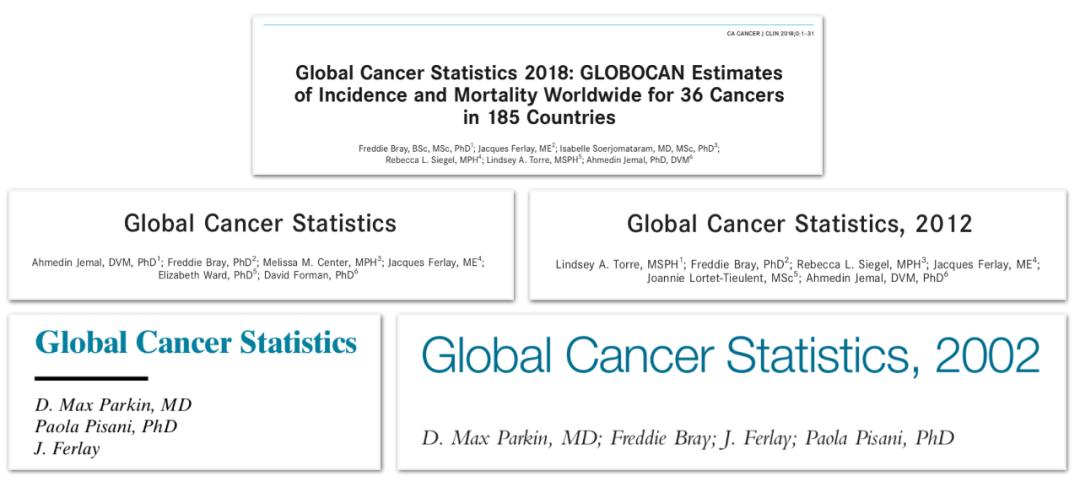
Figure 1.2 Past five editions of global cancer statistics report
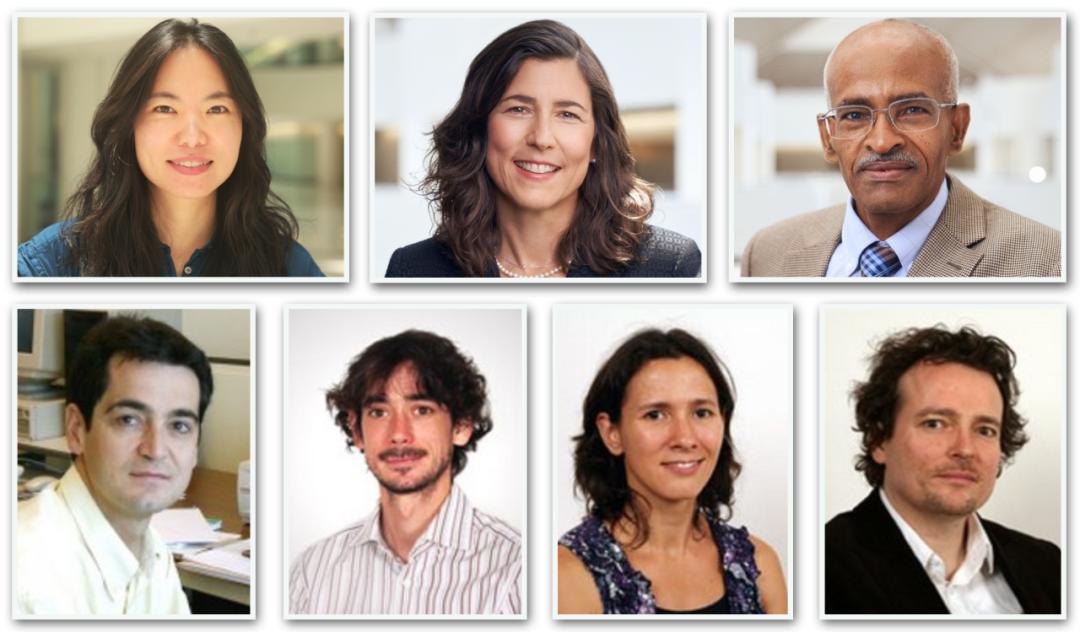
Based on the data of GLOBOCAN 2020, the 2020 edition of Global Cancer Statistics counts the incidence and mortality of 36 cancers in 185 countries around the world. The article was written by four authors from the International Agency for Research on Cancer (IARC) and three authors from the American Cancer Society (ACS), which brought us colorful pictures, detailed data and simple analysis … Next, let’s take a look at the important conclusions of the report!

Figure 1.3 Seven authors who co-wrote the report this year.
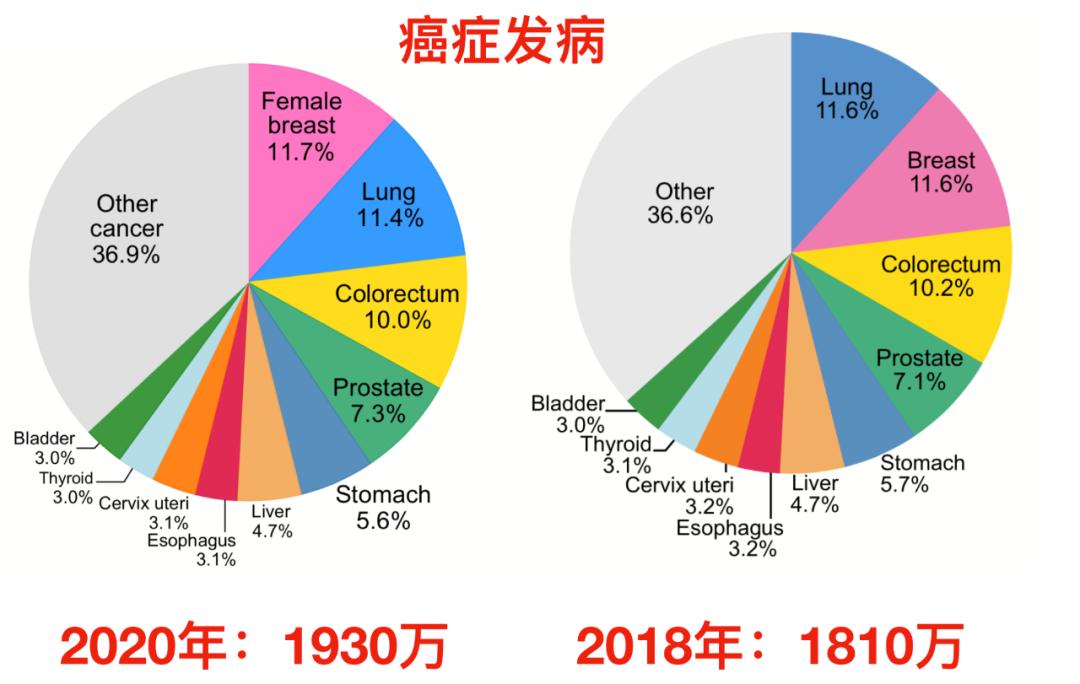
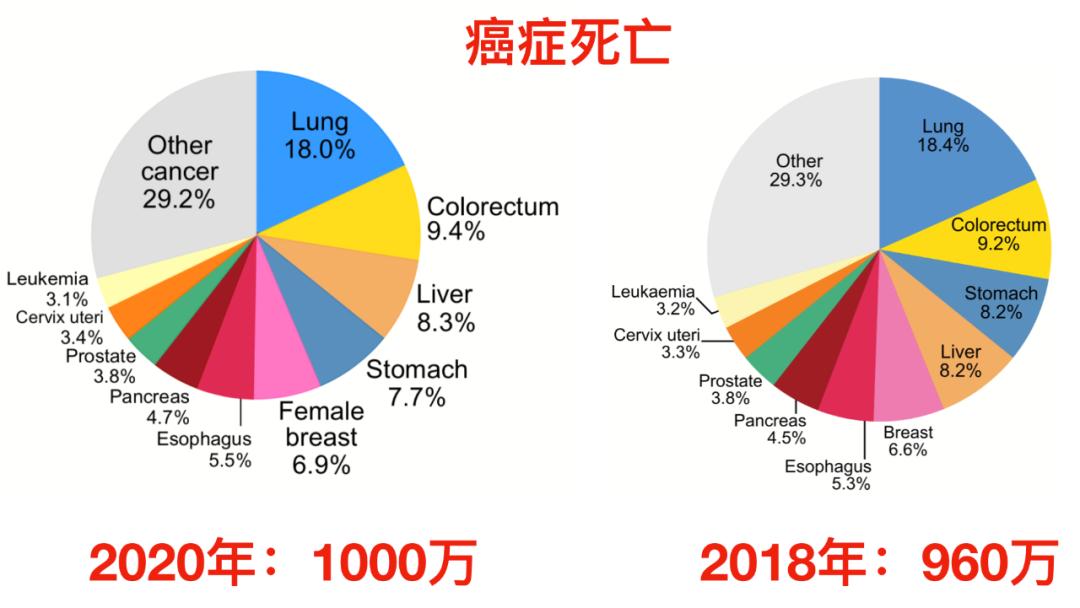
According to this latest report, there were 19.3 million newly diagnosed cancers in the world in 2020, which continued to rise compared with 18.1 million in 2018; Among them, the number of cancer deaths also stands at the tens of millions mark, which is expected to reach 10 million, which unexpectedly exceeds the data of 9.6 million in 2018. This means that one-fifth of men and one-sixth of women in the world will get cancer at some point in their lives, and one-eighth of men and one-eleventh of women will die of cancer, which is still the same as in 2018.

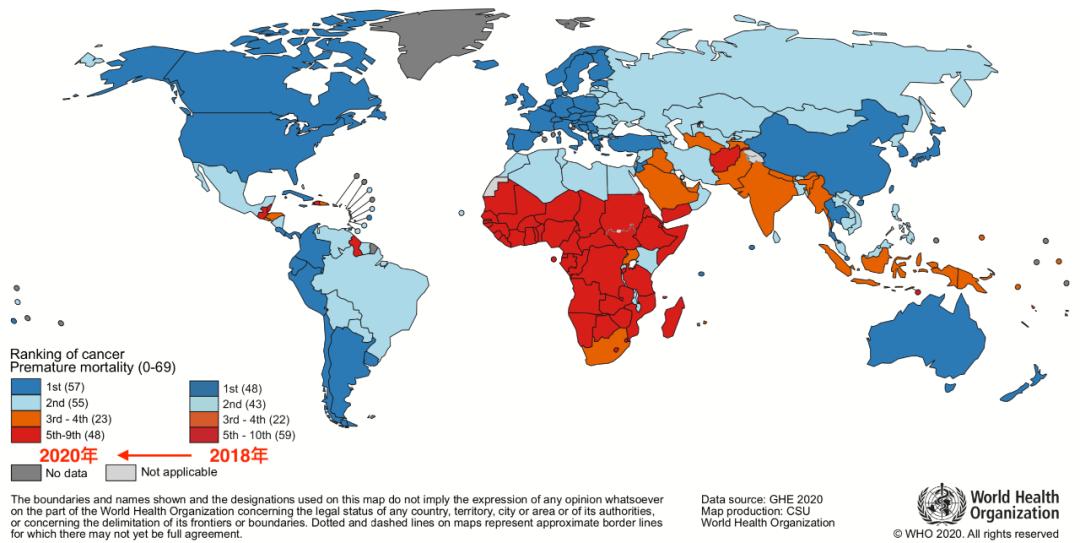
Figure 1.4 Cancer is one of the leading causes of death in most countries/regions in the world.
Among the countries/regions analyzed in the report, cancer deaths are the first or second cause of death in 112 countries/regions, an increase of 21 compared with 2018; The number of countries/regions occupying three or four places has also reached 23, an increase of one compared with 2018. In the report of 2018, cancer was the second cause of death in China, and in this year’s report, Chinese ranked cancer as the first cause of death.

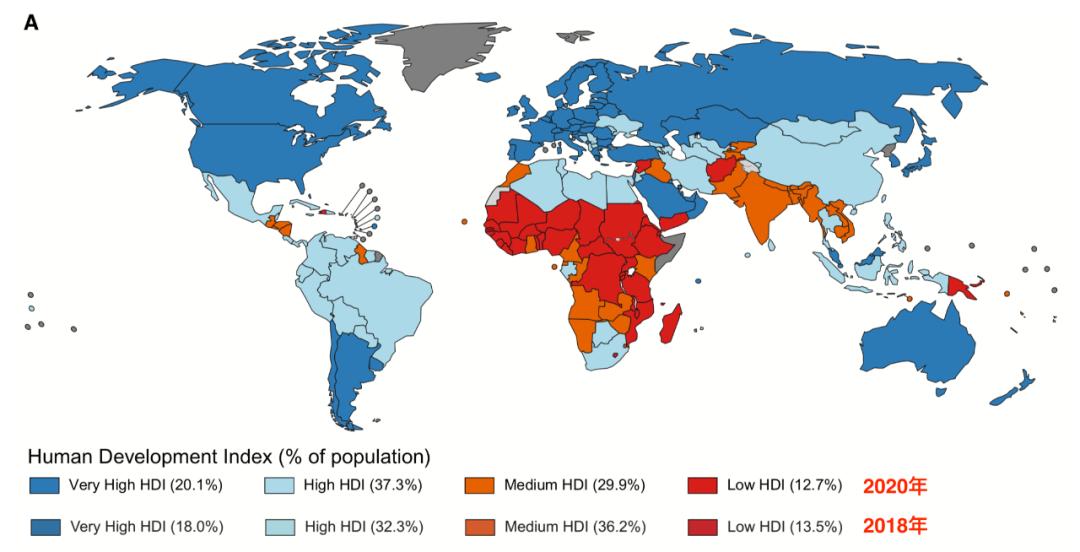
Figure 1.5 Improvement of global socio-economic development level
Generally speaking, the burden of cancer incidence and death in the world is increasing rapidly. This not only reflects the aging of the population and the sustained growth of the population, but also reflects the global social and economic development to some extent. During 2018-2020, the proportion of countries/regions with extremely high and high population development index increased, while the proportion of countries/regions with medium and low population development index decreased accordingly. However, social and economic development seems to bring cancer risk factors while improving people’s lives.
2
The champion changes hands, but lung cancer is still not to be underestimated!

Figure 2.1 Breast cancer has become the first cancer in the world.
The most striking thing about this report is breast cancer! In the proportion of all cancers, breast cancer surpassed lung cancer for the first time and stood as the champion. In 2018, the incidence of breast cancer and lung cancer was 11.6%, but in 2020, it became 11.8% for breast cancer and 11.4% for lung cancer. The next three are still colorectal cancer, prostate cancer and gastric cancer, although the proportion has slightly increased or decreased, but the ranking has not changed.

Figure 2.2 Lung cancer is still the leading cause of death in the world.
However, although the proportion of deaths caused by lung cancer in all cancers decreased to 18.0% in 2020, less than 18.4% in 2018, lung cancer is still the cancer with the largest number of deaths in the world. Subsequently, the proportion of cancer deaths also increased slightly. The four major cancers after lung cancer were colorectal cancer, liver cancer, gastric cancer and breast cancer. It is worth noting that liver cancer surpassed gastric cancer and squeezed into the top three cancer deaths.

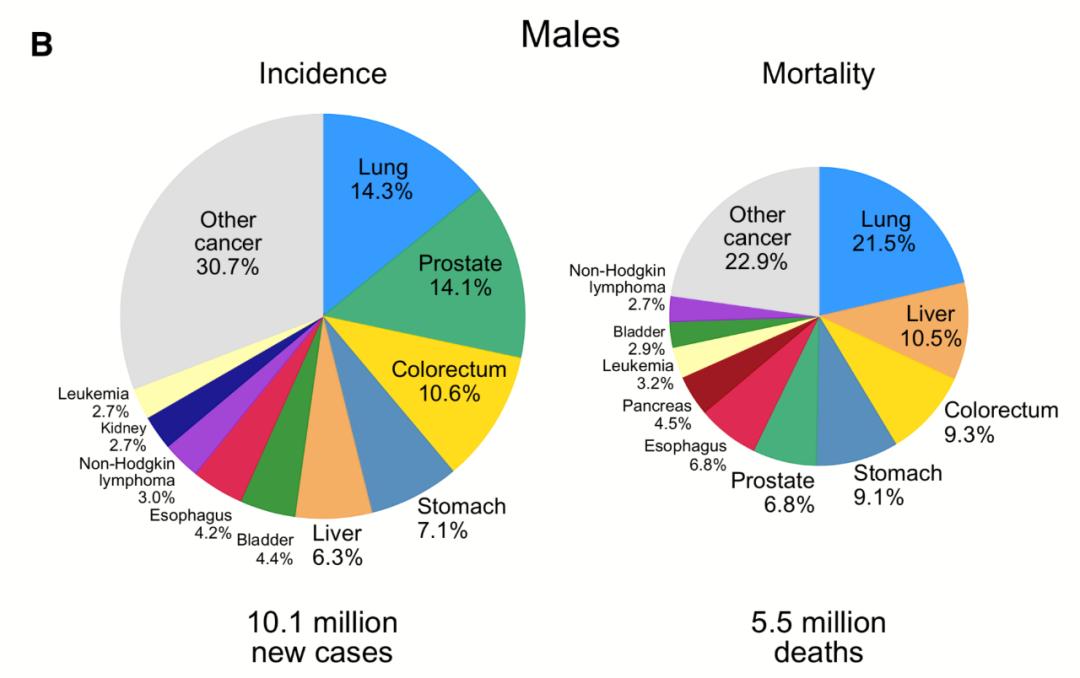
Figure 2.3 Male Cancer Incidence and Death

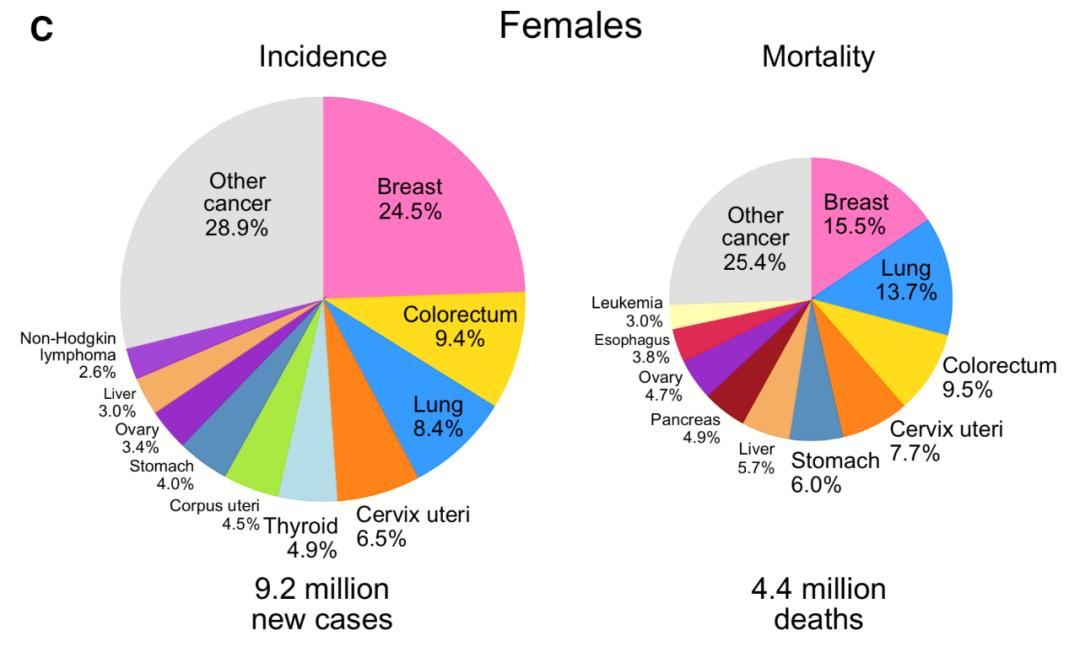
Figure 2.4 Female Cancer Incidence and Death
Cancer is more severe for men. The age-standardized cancer incidence rate (ASR) of men is 222.0 cases/100,000 person-years, which has little change compared with 218.6 cases/100,000 person-years in 2018. The number of women is 186.0/100,000 person-years, which is the same as that of 182.6/100,000 person-years in 2018. However, overall, the incidence of cancer in men is still higher than that in women.
In terms of mortality, the age-standardized cancer mortality rate for men is 120.8 cases/100,000 person-years, which is lower than that of 122.7 cases/100,000 person-years in 2018; Among women, it is 84.2 cases/100,000 person-years, which is still higher than 83.1 cases/100,000 person-years in 2018. However, the cancer mortality rate of men is still nearly 50% higher than that of women.

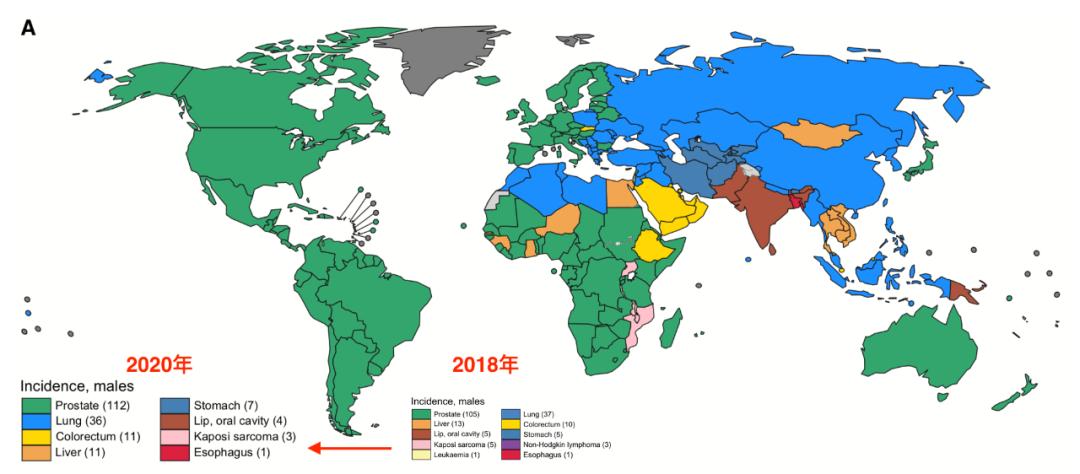
Figure 2.5 Global map of male cancer incidence

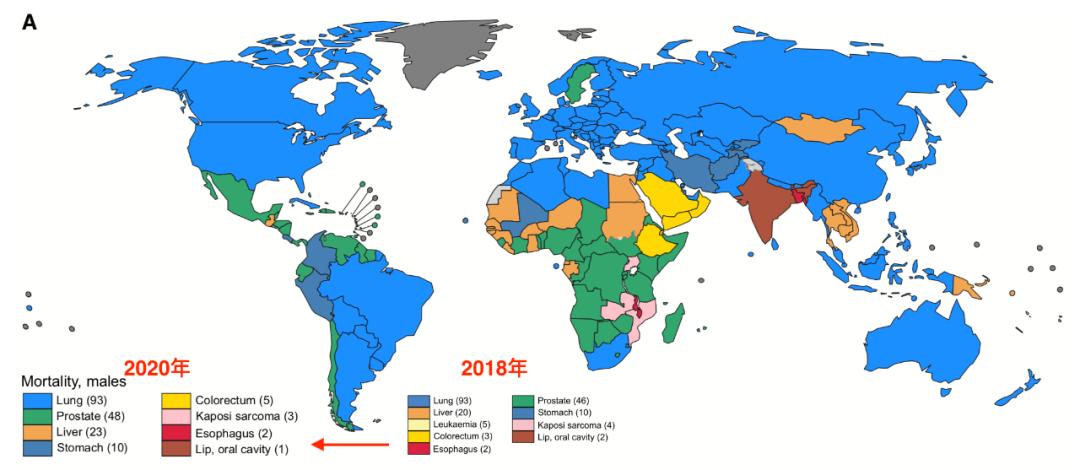
Figure 2.6 Global map of male cancer deaths
The most common cancer among men is lung cancer, accounting for 14.3%, but prostate cancer is the most common cancer in most countries/regions around the world, and lung cancer is the second. However, the incidence of lung cancer among men in China is the highest among all cancers; Other cancers with high incidence in men include colorectal cancer, gastric cancer and liver cancer.
In terms of male cancer deaths, lung cancer continues to lead all cancers, and the proportion of deaths has further increased to 21.5%. It is the leading cancer among men in 93 countries/regions around the world, which is the same as that in 2018. Lung cancer is also the first cancer death among men in China.

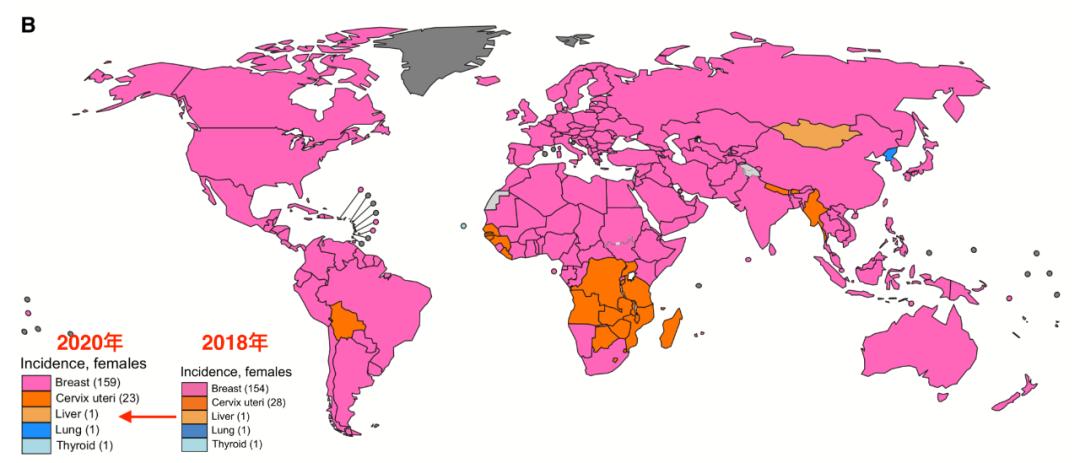
Figure 2.7 Global map of female cancer incidence.

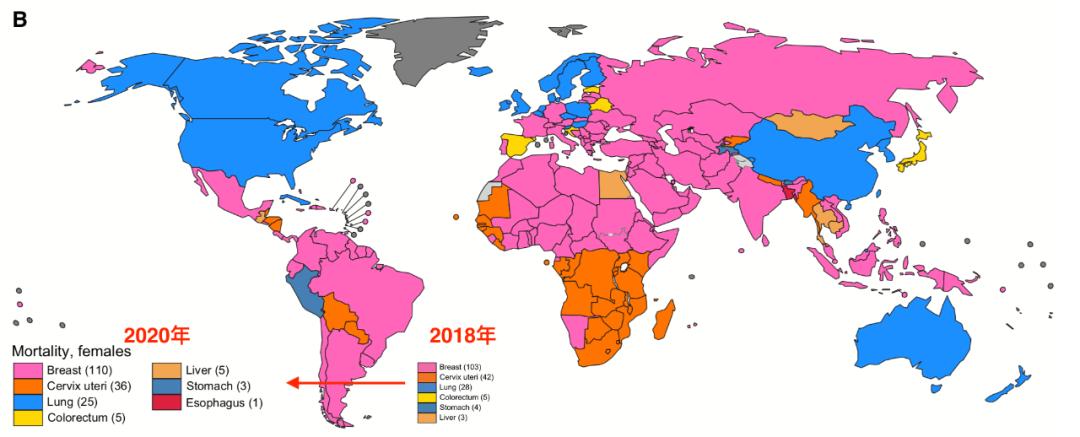
Figure 2.8 Global map of female cancer deaths.
The most common cancer among women is breast cancer, accounting for 24.5%. In 2020, it is the first cancer in 159 countries/regions around the world, which is 5 more than that in 2018. On the map, Wuyang Wuyang is all pink, and China is no exception; Other cancers with high incidence in women include colorectal cancer, lung cancer and cervical cancer.
In terms of mortality, breast cancer continues to occupy the first place, accounting for 15.5%; Followed by lung cancer, colorectal cancer and cervical cancer. However, because the most common cause of cancer death among women in China, the United States, Canada, Australia and other countries is lung cancer, the map of cancer death among women doesn’t look so pink, but the number of countries/regions with the first breast cancer death has increased from 103 in 2018 to 110.

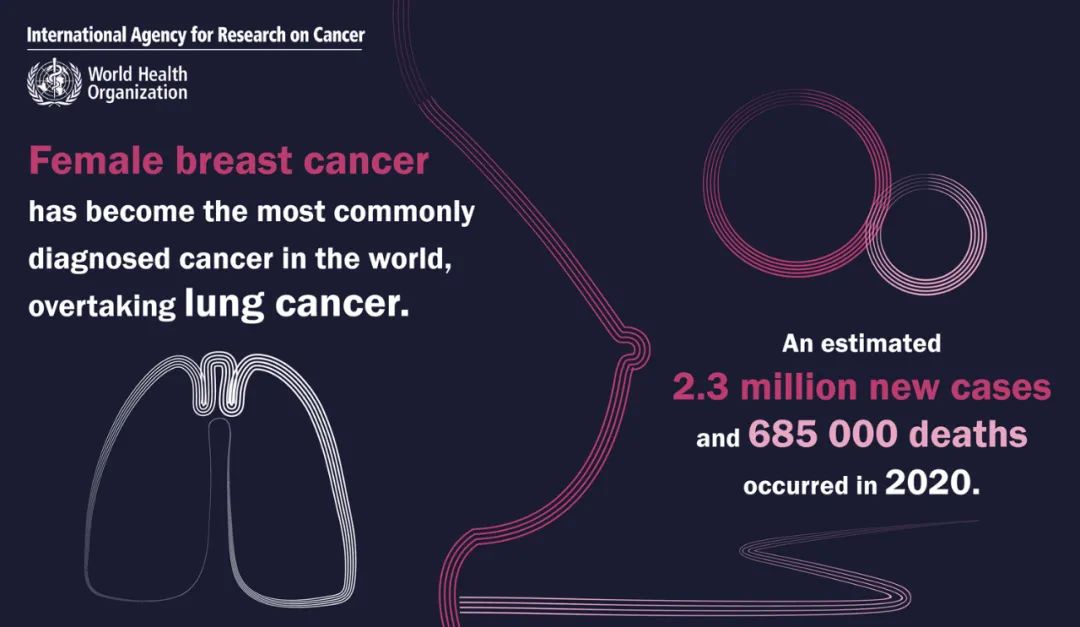
Figure 2.9 Breast cancer surpassed lung cancer as the most common cancer.

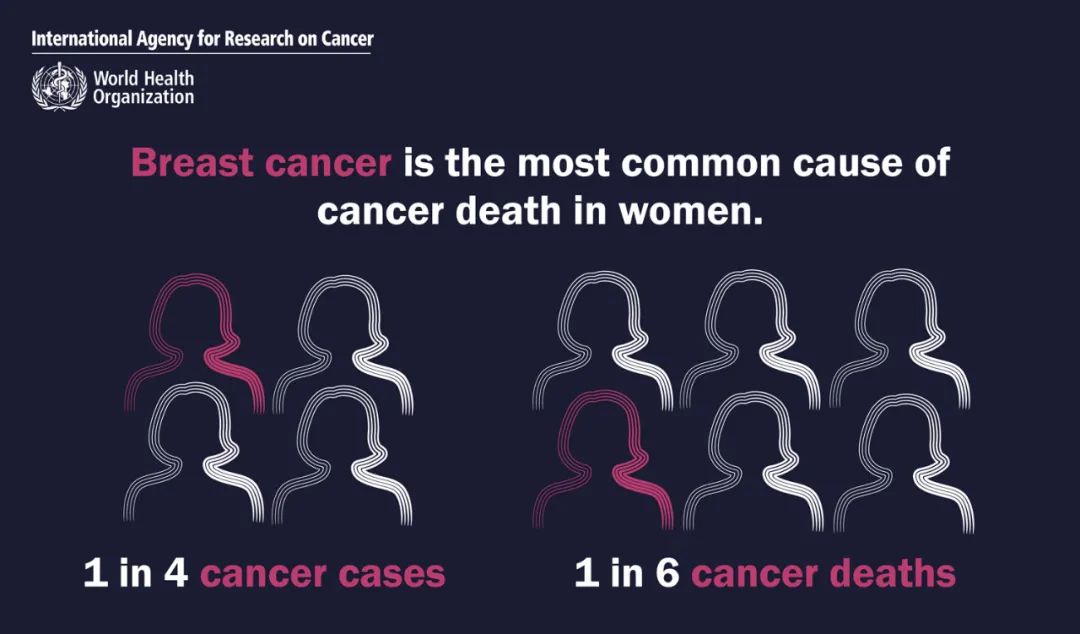
Figure 2.10 1/4 of female cancers and 1/6 of female cancer deaths are all breast cancer.
Breast cancer is the focus of this report, and two posters have been specially released on the homepage of the International Agency for Research on Cancer, hoping that everyone will pay attention to breast cancer. The poster emphasizes that in 2020, 2.3 million women will unfortunately get breast cancer, and 685,000 women will unfortunately die of breast cancer. This figure means that one quarter of all female cancer patients are breast cancer patients; Of all the women who died of cancer, 1/6 died of breast cancer.
three
China has attracted great attention, and the overall proportion has declined steadily!

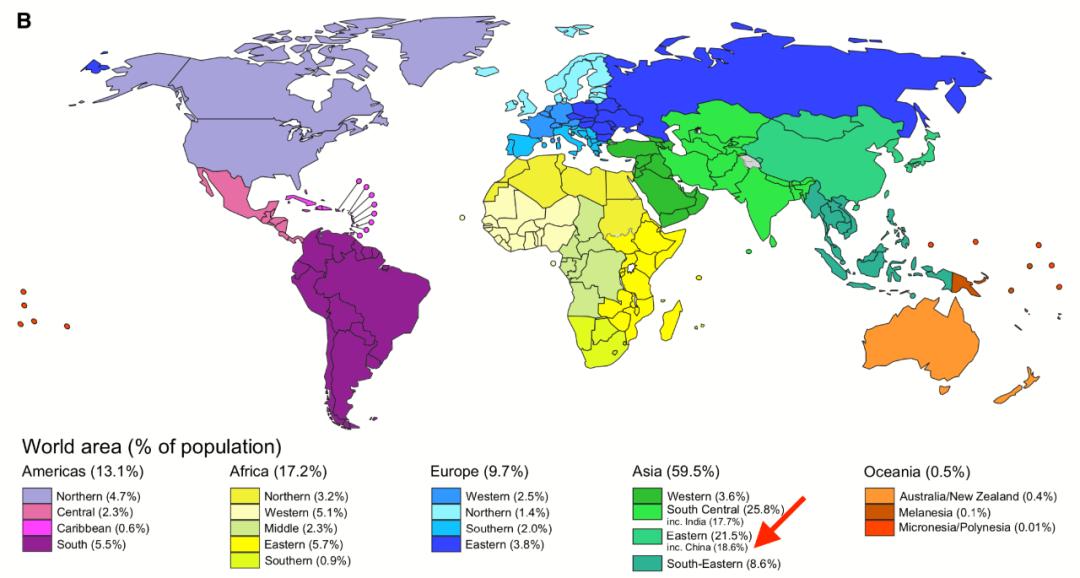
Figure 3.1 There are so many people that they need to make a separate list.
There are so many Chinese, so many global cancer reports have to list one for China. In this report, the proportion of population in Asia is 59.5%, that in East Asia is 21.5%, and that in China is 18.6%. The proportion of China in the report is close to 1/5, which directly divides the statistical analysis of East Asia into other places except China and China.

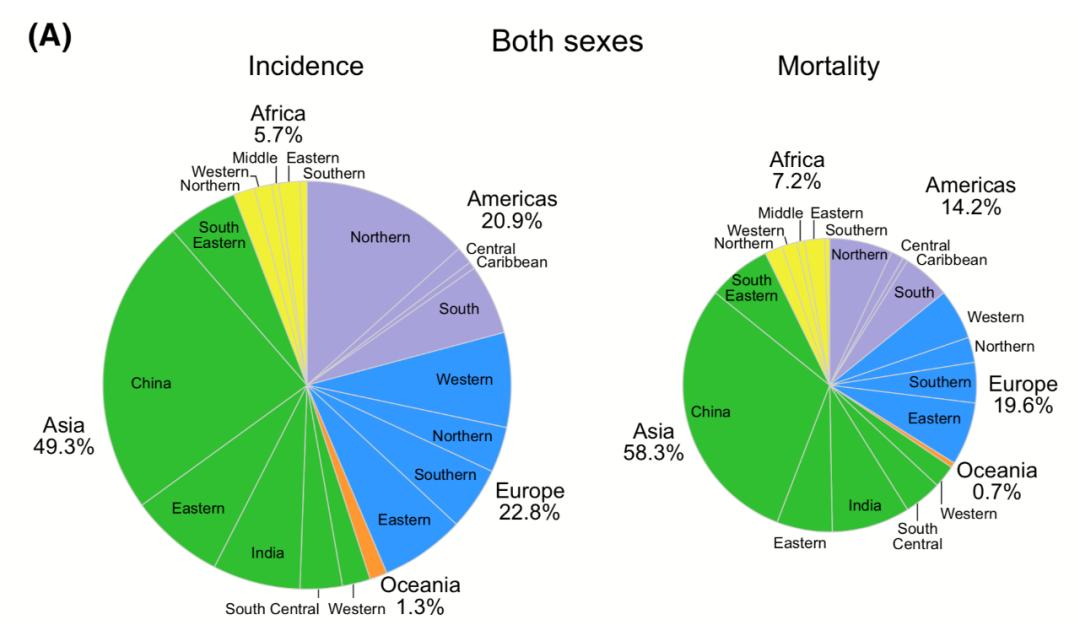
Figure 3.2 Regional Distribution of Cancer Incidence and Death in the World
There are many Asians, so are the corresponding cancers, accounting for 49.3% of all cancers in the world, of which China accounts for about a quarter of the world; Cancer deaths from Asia are more than half, reaching 58.3%, of which China accounts for more than a quarter of the world’s total. Although Europe accounts for less than 1/10 of the global population, it contributes 22.8% of cancer cases and 19.6% of cancer deaths. America accounts for about 1/5 of the world’s population, but it also contributes 20.9% of cancer cases and 14.2% of cancer deaths. Compared with Europe and America, the proportion of cancer deaths in Asia and Africa is higher than that in cancer incidence, suggesting that the mortality rate of cancer patients in these areas is higher.

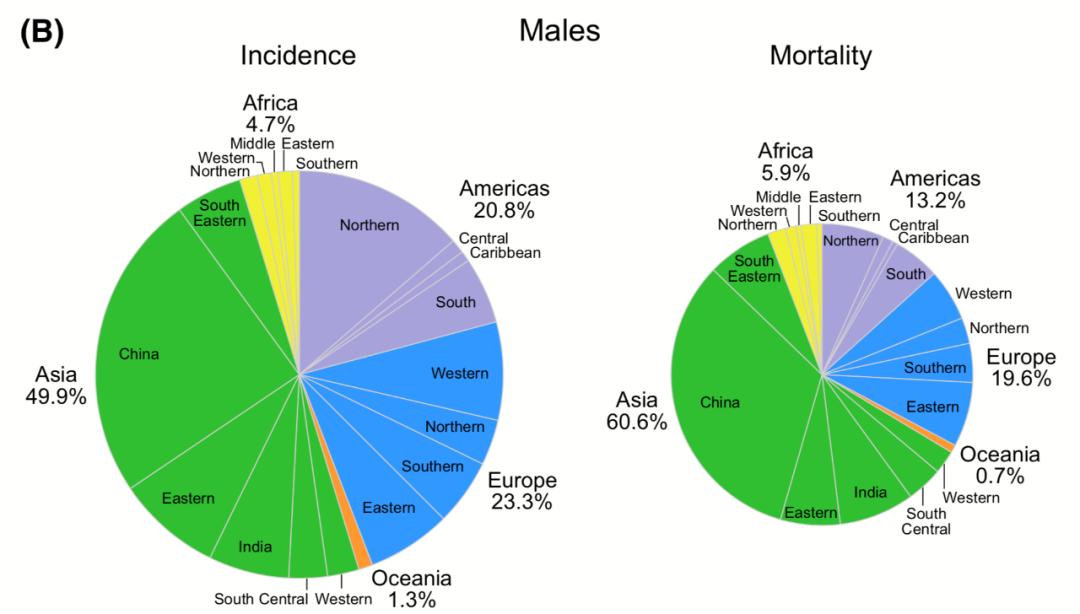
Figure 3.3 Global proportion of male cancer incidence and death in China.
The age-standardized cancer incidence rate of men in China is 225.4 cases/100,000 person-years, which is not only higher than the global average of 222.0 cases/100,000 person-years, but also higher than the own data of 223.0 cases/100,000 person-years in 2018. In terms of mortality, the age-standardized cancer mortality rate of men in China is 163.9 cases/100,000 person-years, which is significantly higher than the global average of 120.8 cases/100,000 person-years, but it is better than the data of 166.6 cases/100,000 person-years in 2018.

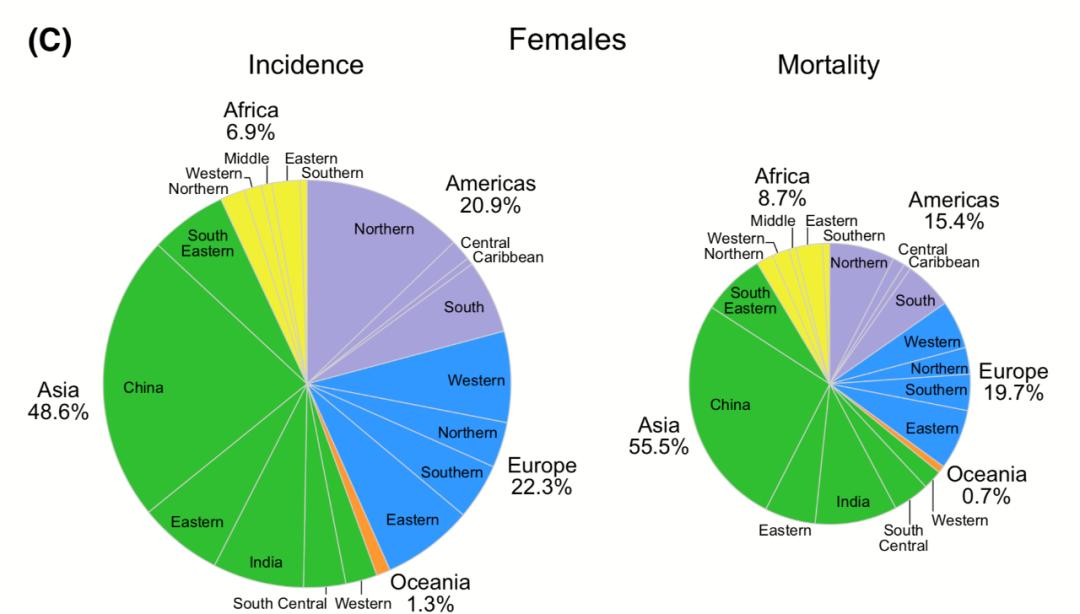
Figure 3.4 Global proportion of female cancer incidence and death in China.
The age-standardized cancer incidence rate of women in China is 188.2 cases/100,000 person-years, which is lower than that of men in China, but it is still higher than the global average of 186.0 cases/100,000 person-years, and it is also higher than its own data of 182.6 cases/100,000 person-years in 2018. In terms of mortality, the age-standardized cancer mortality rate of women in China is 98.1 cases/100,000 person-years, higher than the global average of 84.2 cases/100,000 person-years, and higher than the data of 95.2 cases/100,000 person-years in 2018.

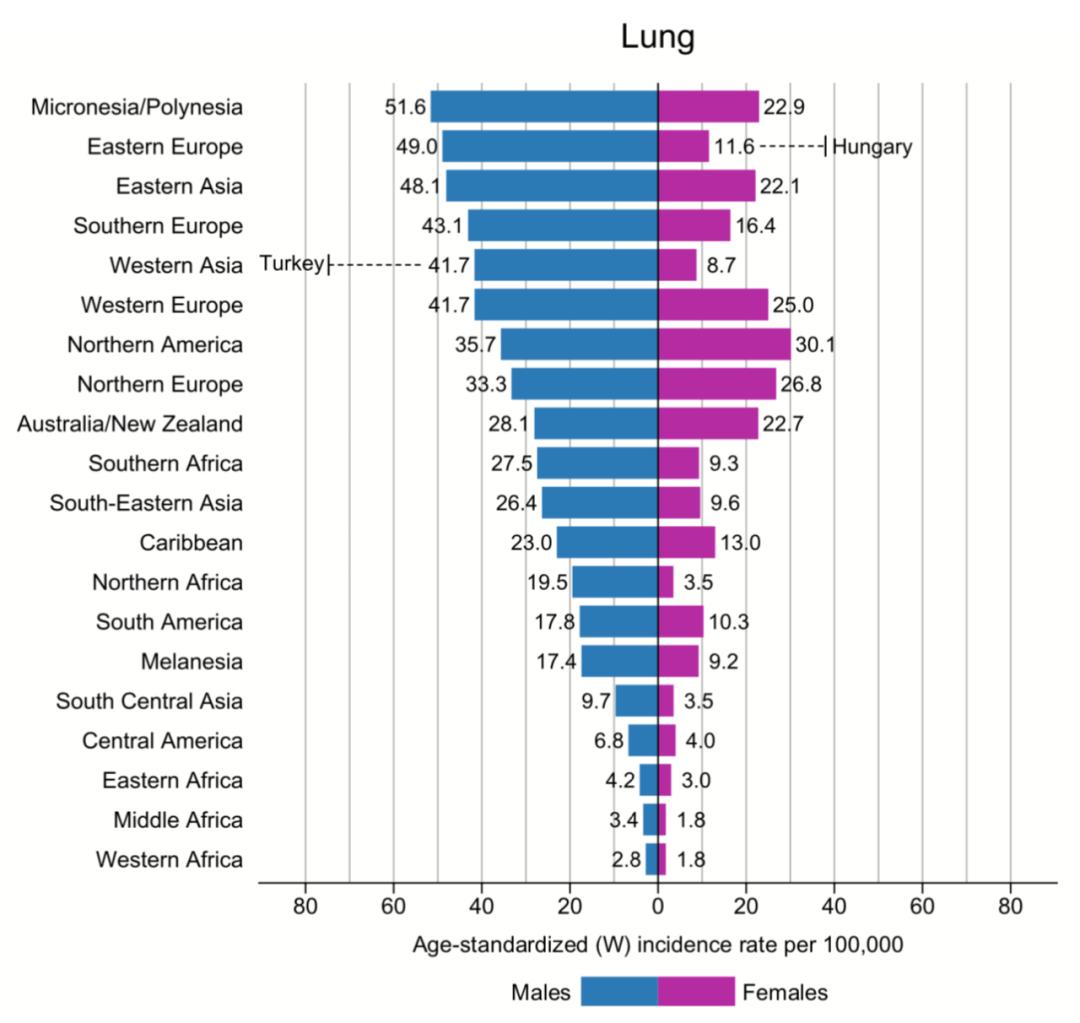
Figure 3.5 Global incidence of lung cancer
The report covers the situation of several common cancers in China. Firstly, it is pointed out that the incidence of lung cancer in East Asia is relatively high, mainly because the burden of lung cancer in China is heavier. Although tobacco is still the most important risk factor for lung cancer, the smoking rate of women in China is low, and it seems that tobacco can’t be blamed for their lung cancer. The main risk factors of these female lung cancer patients may come from air pollution, including outdoor air pollution and air pollution caused by burning domestic solid fuel for heating and cooking.

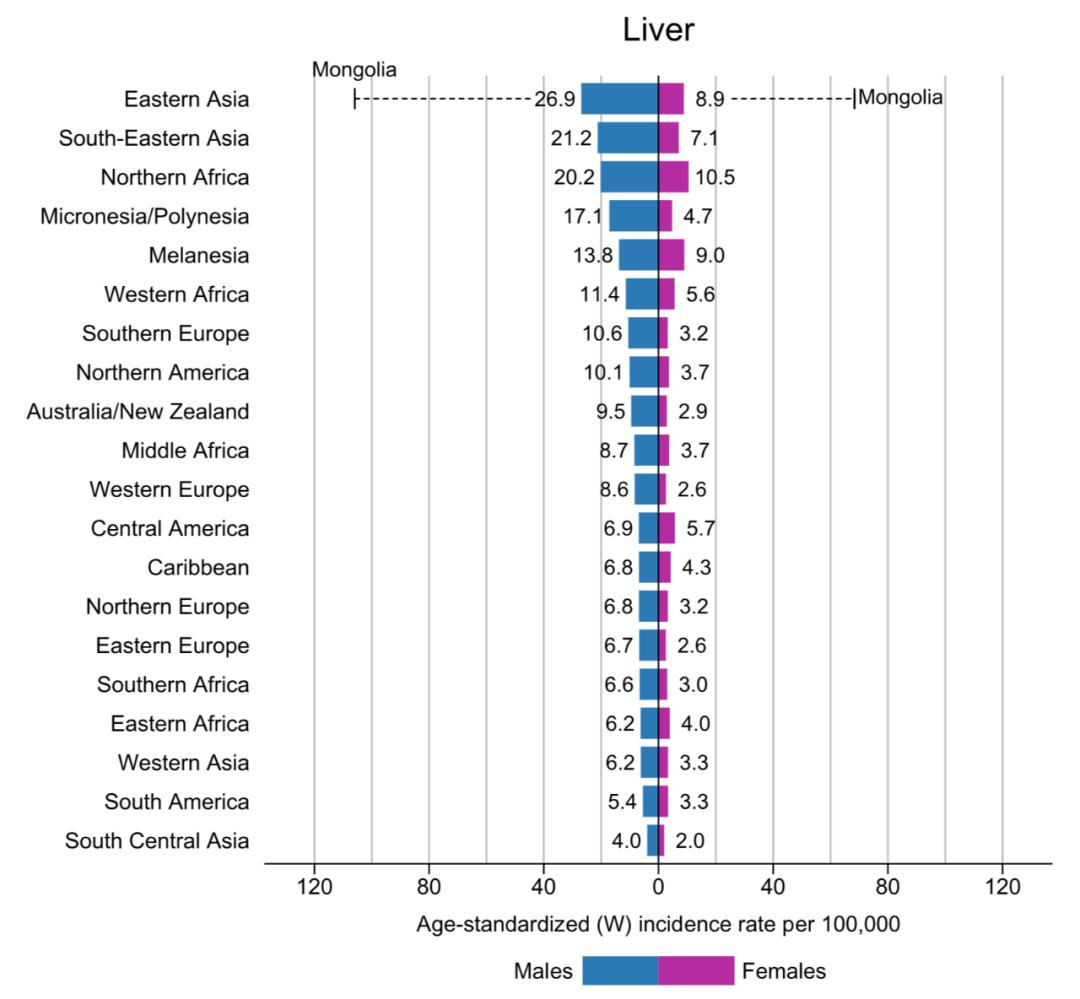
Figure 3.6 Global incidence of liver cancer
The main risk factor of liver cancer is chronic infection of hepatitis B virus or hepatitis C virus, accounting for 56% and 20% of liver cancer cases respectively. The main risk factor of liver cancer in China is hepatitis B infection. However, with the introduction of hepatitis B vaccine, the infection rate of hepatitis B has decreased, and there is no soil for liver cancer related to infection. Since 1970s, the incidence and mortality of liver cancer have decreased in many high-risk countries in East and Southeast Asia, including China. It is believed that the burden of hepatitis B-related liver cancer will continue to decrease in the future.

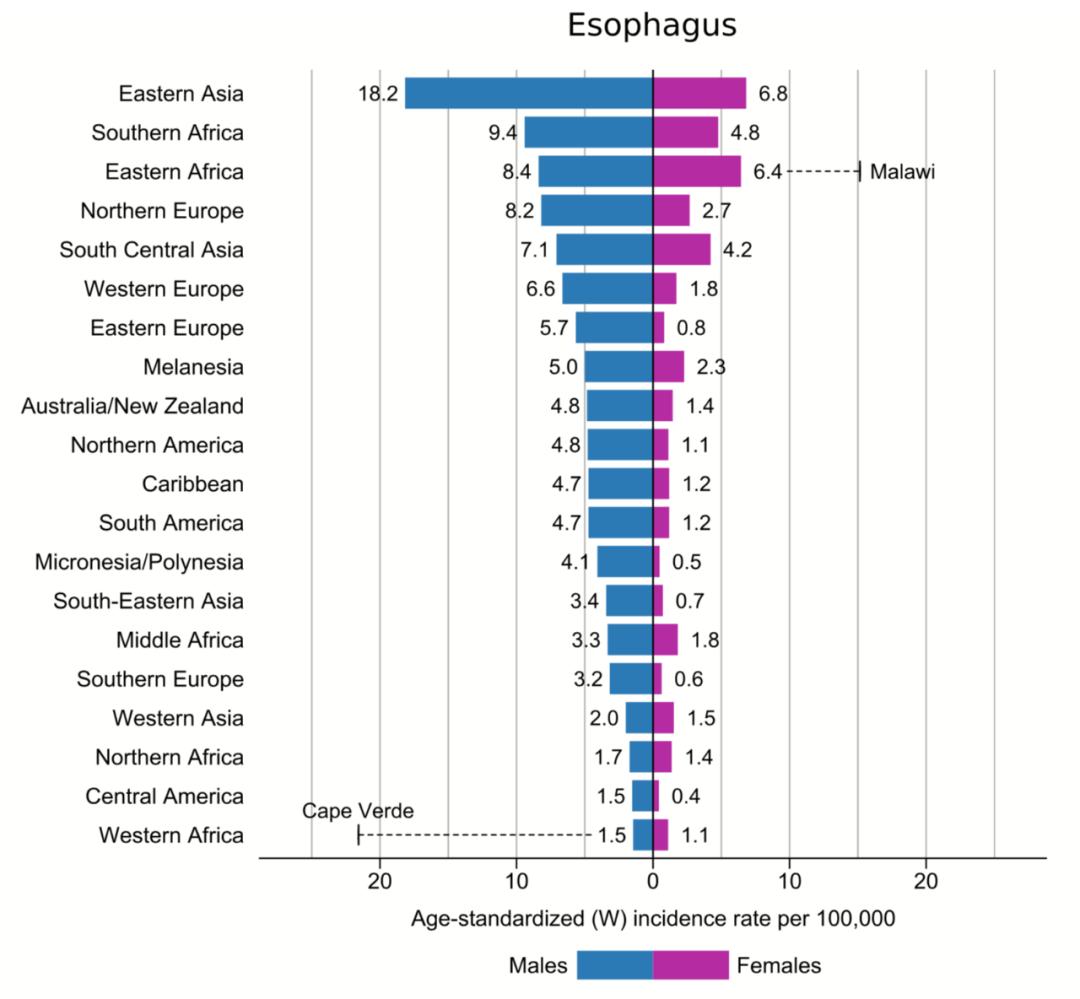
Figure 3.7 Global incidence of esophageal cancer
Although the incidence and mortality of esophageal cancer are not prominent among all cancers in the world, one out of every 18 cancer deaths in 2020 is esophageal cancer, of which about 70% are men. The burden of esophageal cancer in China is very heavy, which directly pushes East Asia to the position with the heaviest burden of esophageal cancer in the world. Nutritional deficiency, nitrosamines, eat areca, pickles, very hot food and drinks may be the most important risk factors.

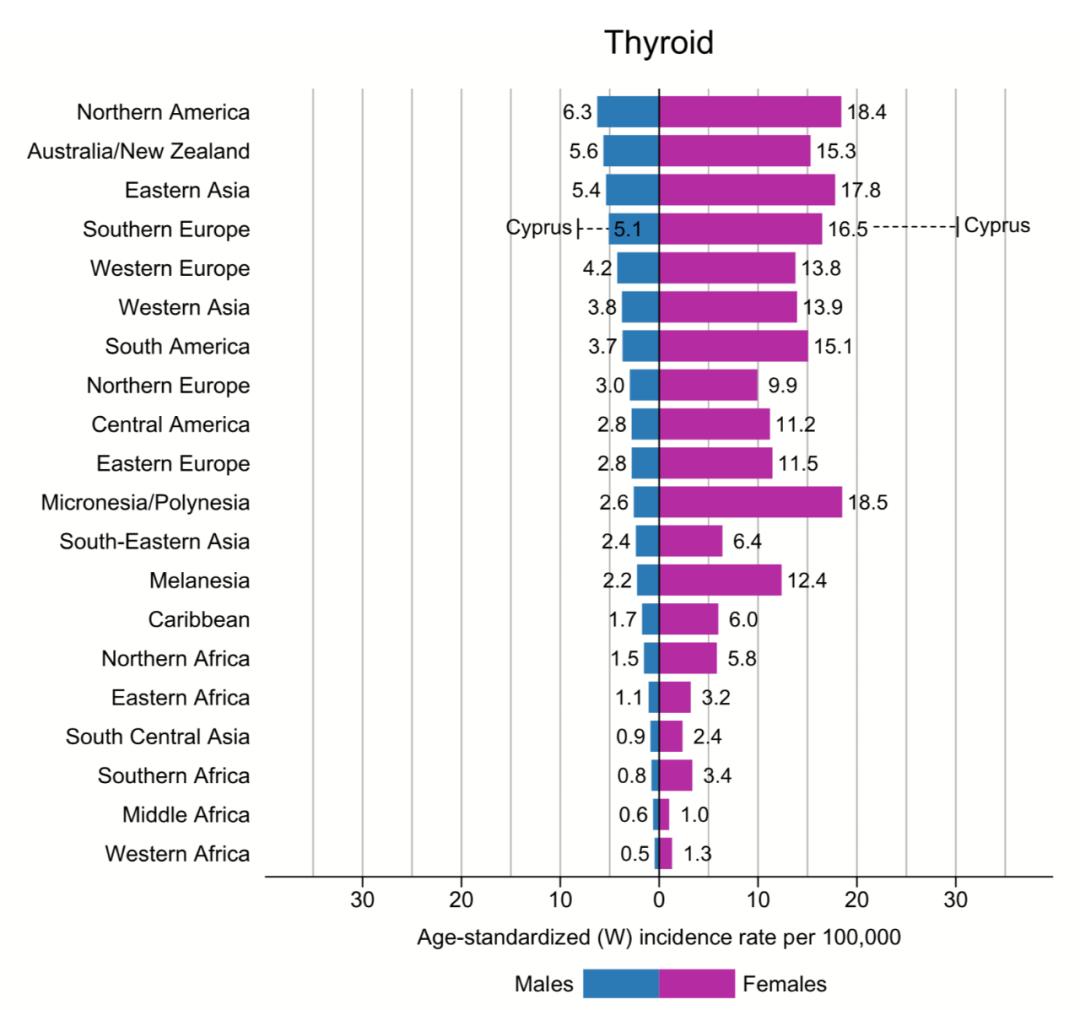
Figure 3.8 Global incidence of thyroid cancer
The incidence of thyroid cancer is increasing all over the world, but most thyroid cancers may not be fatal. With the popularization of ultrasound and other diagnostic imaging examinations, a large number of subclinical inert thyroid lesions have been found. It is estimated that in China, South Korea, Italy and other countries, over-diagnosed thyroid cancer cases accounted for 80% ~ 95% of newly diagnosed cases from 2008 to 2012. However, the recent guidelines have gradually turned to suggest that thyroid cancer should not be screened, and advocate active monitoring strategy for tiny thyroid cancer, rather than completely.
four
The burden doubles, and cancer still depends on prevention!

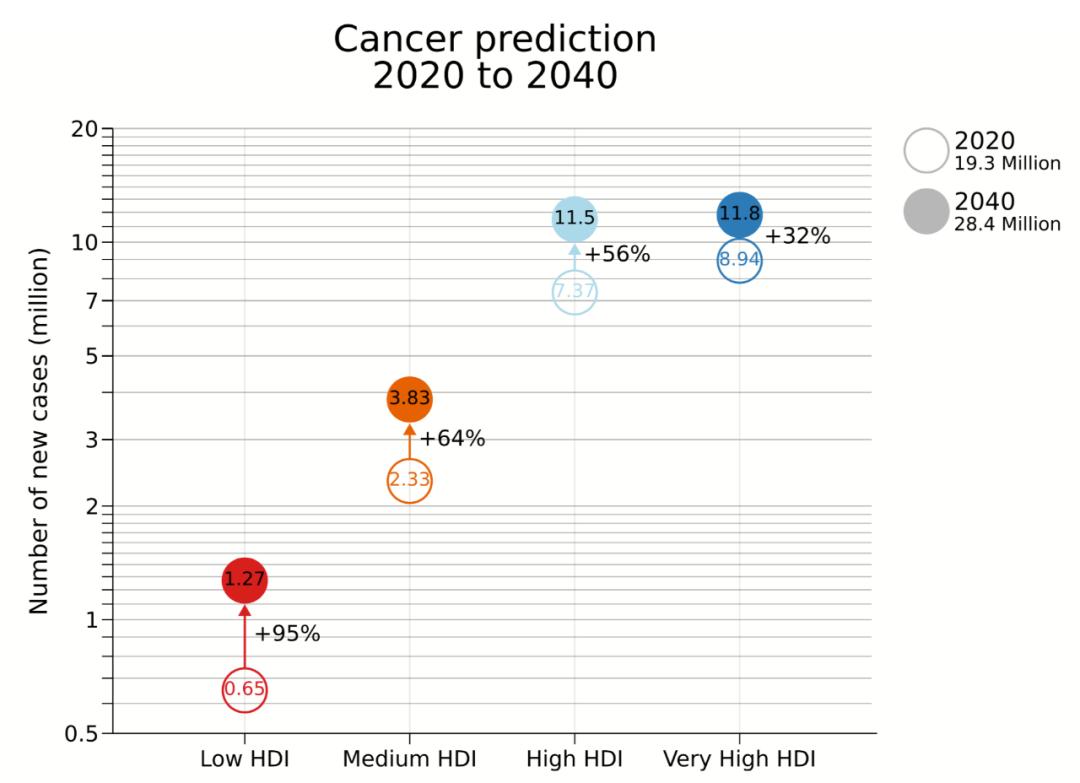
Figure 4.1 It is conservatively predicted that there will be 28.4 million new cases of cancer in 2040.
At the end of the report, the global cancer incidence and death in the next 20 years are also prospected, but the situation seems to be not optimistic. Assuming that the incidence of cancer in the future remains at the level of 2020, it is estimated that there will be 28.4 million new cancer cases in the world by 2040, an increase of 47% over 2020. Among them, the number of cases in countries/regions with medium and low population development index increased more significantly, reaching 95% and 64% respectively. As far as the absolute number of cancer patients is concerned, countries/regions with high population development index have the heaviest burden, and the number of new cases will increase by 4.1 million in 2040, and China is just such a case. According to the report, the current forecast is entirely based on population growth and aging, and since the risk factors of cancer may continue to increase in many parts of the world, it is expected that the real number may be even more shocking.

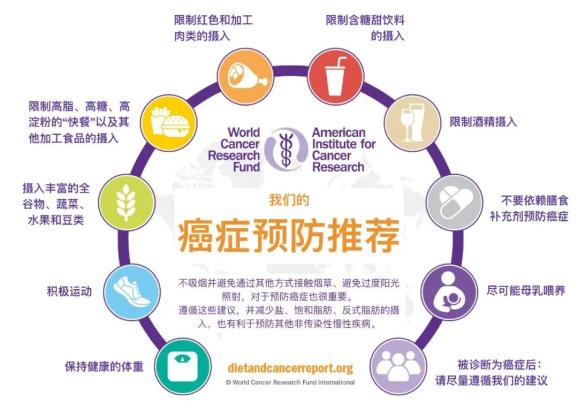
Figure 4.2 Ten Advice for Cancer Prevention
With the development of social economy, cancers related to infection and poverty, such as cervical cancer, liver cancer and gastric cancer, may gradually decrease, while cancers related to various unhealthy lifestyles will gradually increase. Well-known cancer risk factors include smoking, unhealthy diet, overweight and lack of exercise, which may further increase the burden of breast cancer, lung cancer, colorectal cancer and prostate cancer. In order to reduce the burden and risk of cancer in the future, targeted preventive measures and corresponding cancer treatment methods may be the focus.
related articles
References:
[1]Parkin DM,Pisani P,Ferlay J.Global cancer statistics.CA Cancer J Clin.1999 Jan-Feb; 49(1):33-64,1.doi:10.3322/canjclin.49.1.33.
[2]Parkin DM,Bray F,Ferlay J,Pisani P.Global cancer statistics,2002.CA Cancer J Clin.2005 Mar-Apr; 55(2):74-108.doi:10.3322/canjclin.55.2.74.
[3]Jemal A,Bray F,Center MM,Ferlay J,Ward E,Forman D.Global cancer statistics.CA Cancer J Clin.2011 Mar-Apr; 61(2):69-90.doi:10.3322/caac.20107.
[4]Torre LA,Bray F,Siegel RL,Ferlay J,Lortet-Tieulent J,Jemal A.Global cancer statistics,2012.CA Cancer J Clin.2015 Mar; 65(2):87-108.doi:10.3322/caac.21262.
[5]Bray F,Ferlay J,Soerjomataram I,Siegel RL,Torre LA, Jemal A.Global cancer statistics 2018:GLOBOCAN estimates of incidence and mortality worldwide for 36 cancers in 185 countries.CA Cancer J Clin.2018 Nov; 68(6):394-424.doi:10.3322/caac.21492.
[6]Sung H,Ferlay J,Siegel RL,Laversanne M,Soerjomataram I,Jemal A, Bray F.Global cancer statistics 2020:GLOBOCAN estimates of incidence and mortality worldwide for 36 cancers in 185 countries.CA Cancer J Clin.2021 Feb 4.doi:10.3322/caac.21660.
This article starts: medical oncology channel
Author: Whale
Original title: "Cancer ranks first in China! The 2020 global cancer statistics report is released, and you must know these changes! 》
Read the original text
CCTV News:According to the website of the National Bureau of Statistics, in the first half of the year, China’s economy continued to recover steadily, production demand continued to pick up, employment prices were generally stable, new kinetic energy grew rapidly, quality and efficiency improved steadily, market players expected to improve, main macro indicators were in a reasonable range, and economic development showed a good trend of stability, reinforcement and stability.
According to preliminary accounting, the GDP in the first half of the year was 53,216.7 billion yuan, up 12.7% year-on-year at comparable prices, down 5.6 percentage points from the first quarter. The average growth rate in two years was 5.3%, and the average growth rate in two years was 0.3 percentage points faster than that in the first quarter. Quarterly, the first quarter increased by 18.3% year-on-year, with an average growth of 5.0% in two years; It increased by 7.9% in the second quarter and 5.5% on average in two years. In terms of industries, the added value of the primary industry in the first half of the year was 2,840.2 billion yuan, up 7.8% year-on-year, with an average growth of 4.3% in two years; The added value of the secondary industry was 20,715.4 billion yuan, a year-on-year increase of 14.8%, with an average increase of 6.1% in two years; The added value of the tertiary industry was 29,661.1 billion yuan, up 11.8% year-on-year, with an average growth of 4.9% in two years. From the ring comparison, the GDP in the second quarter increased by 1.3%.
First, the summer grain was harvested again, and animal husbandry production grew steadily.
In the first half of the year, the added value of agriculture (planting) increased by 3.6% year-on-year, and the growth rate was 0.3 percentage points faster than that in the first quarter; Average growth of 3.7% in two years. Among them, the growth in the second quarter was 3.7%, 0.4 percentage points faster than that in the first quarter. The total output of summer grain in China was 145.82 million tons (291.6 billion Jin), an increase of 2.967 million tons (5.93 billion Jin) or 2.1% over the previous year. The agricultural planting structure has been continuously optimized, and the planting area of cash crops such as rapeseed has increased. In the first half of the year, the output of pork, cattle, sheep and poultry was 42.91 million tons, up by 23.0% over the same period of last year, of which the output of pork increased by 35.9%. Milk production increased by 7.6% year-on-year, while poultry and eggs production decreased by 4.1%. At the end of the second quarter, the number of live pigs was 439.11 million, a year-on-year increase of 29.2%; Among them, there are 45.64 million sows that can breed, an increase of 25.7%.
II. Steady growth of industrial production and rapid growth of high-tech manufacturing.
In the first half of the year, the added value of industrial enterprises above designated size increased by 15.9% year-on-year, with an average growth rate of 7.0% in two years, 0.2 percentage points faster than that in the first quarter; Among them, the second quarter increased by 8.9% year-on-year. In June, the added value of industrial enterprises above designated size increased by 8.3% year-on-year, with an average increase of 6.5% in two years; The chain increased by 0.56%. In terms of three categories, the added value of the mining industry increased by 6.2% in the first half of the year, with an average increase of 2.5% in two years; The manufacturing industry grew by 17.1%, with an average growth rate of 7.5% in two years; Electricity, heat, gas and water production and supply industries grew by 13.4%, with an average growth of 6.0% in two years. The added value of high-tech manufacturing industry increased by 22.6% year-on-year, with an average increase of 13.2% in two years. In terms of products, the output of new energy vehicles, industrial robots and integrated circuits increased by 205.0%, 69.8% and 48.1% respectively year-on-year, and the average growth rate in both years exceeded 30%. In terms of economic types, the added value of state-owned holding enterprises increased by 11.9% year-on-year; Joint-stock enterprises increased by 15.8% year-on-year, and foreign-invested enterprises from Hong Kong, Macao and Taiwan increased by 17.0% year-on-year; Private enterprises increased by 18.3% year on year. In June, the purchasing managers’ index of China manufacturing industry was 50.9%, which was higher than the critical point for 16 consecutive months. The expected index of enterprise’s production and operation activities is 57.9%.
From January to May, the total profits of industrial enterprises above designated size nationwide reached 3,424.7 billion yuan, up 83.4% year-on-year, with an average increase of 21.7% in two years. The profit rate of operating income of industrial enterprises above designated size is 7.11%, which is 2.05 percentage points higher than that of January-May 2020.
Third, the service industry recovered steadily and the market expectation continued to improve.
In the first half of the year, the tertiary industry continued to recover steadily. In the second quarter, the added value of the tertiary industry increased by 8.3% year-on-year, with an average growth of 5.1% in two years; The growth rate in the first quarter was 15.6% year-on-year, with an average growth rate of 4.7% in two years. In terms of industries, the added value of transportation, warehousing and postal services, information transmission, software and information technology services increased by 21.0% and 20.3% respectively in the first half of the year, with an average increase of 6.9% and 17.3% respectively in the two years. In June, the national service industry production index increased by 10.9% year-on-year, with an average growth of 6.5% in two years. From January to May, the operating income of service enterprises above designated size increased by 31.9% year-on-year, with an average increase of 11.1% in two years, 0.2 percentage points higher than that in January-April.
In June, the business activity index of service industry was 52.3%, which was higher than the critical point for 16 consecutive months. From the industry situation, the business activity indexes of postal express, telecommunications, radio and television, satellite transmission services, internet software and information technology services, which are closely related to online consumption, are all in the higher boom range of more than 57.0%; Monetary and financial services and insurance are all located in the high-level boom zone above 60.0%. From the market expectation, the expected index of business activities is 60.4%, which continues to remain at a high level.
Four, the market sales gradually improved, and the consumption of upgraded goods increased rapidly.
In the first half of the year, the total retail sales of social consumer goods was 21,190.4 billion yuan, up 23.0% year-on-year, with an average growth of 4.4% in two years, 0.2 percentage points faster than that in the first quarter; Among them, the growth rate in the second quarter was 13.9% year-on-year, with an average growth rate of 4.6% in two years. In June, the total retail sales of social consumer goods was 3,758.6 billion yuan, up 12.1% year-on-year, with an average growth of 4.9% in two years. The chain increased by 0.70%. In the first half of the year, according to the location of business units, the retail sales of urban consumer goods was 18,409.8 billion yuan, up 23.3% year-on-year, with an average growth of 4.4% in two years; The retail sales of rural consumer goods reached 2,780.7 billion yuan, up 21.4% year-on-year, with an average growth of 4.0% in two years. By consumption type, the retail sales of commodities reached 19,019.2 billion yuan, up 20.6% year-on-year, with an average growth of 4.9% in two years. The catering revenue was 2,171.2 billion yuan, a year-on-year increase of 48.6%, and the scale was basically the same as that in the first half of 2019. By commodity category, the year-on-year growth rate of 18 commodity categories of units above designated size all exceeded 10%, of which more than 70% commodity categories grew at a year-on-year rate of more than 20%. From the two-year average growth rate, except for petroleum commodities, the retail sales of other commodity categories are all positive growth, among which the average growth rate of retail sales of nine categories of commodities such as sports and entertainment products, communication equipment, cosmetics and cultural office supplies exceeds 10% in two years. The national online retail sales reached 6,113.3 billion yuan, up 23.2% year-on-year, with an average growth of 15.0% in two years, 1.5 percentage points faster than that in the first quarter. Among them,The online retail sales of physical goods reached 5,026.3 billion yuan, an increase of 18.7%, with an average increase of 16.5% in two years, 1.1 percentage points faster than that in the first quarter; The online retail sales of physical goods accounted for 23.7% of the total retail sales of consumer goods, an increase of 1.8 percentage points over the first quarter.
5. Fixed assets investment continued to recover, and the average growth rate of manufacturing investment accelerated in two years.
In the first half of the year, China’s fixed assets investment (excluding farmers) was 25.59 trillion yuan, up 12.6% year-on-year, and 0.35% month-on-month in June. The average growth rate in two years was 4.4%, 1.5 percentage points faster than that in the first quarter. In terms of fields, infrastructure investment in the first half of the year increased by 7.8% year-on-year, with an average increase of 2.4% in two years, slightly lower than that in January-May; Manufacturing investment increased by 19.2% year-on-year, with an average growth of 2.0% in two years, 1.4 percentage points faster than that in January-May; Investment in real estate development increased by 15.0% year-on-year, with an average increase of 8.2% in two years, slightly lower than that in January-May. The national commercial housing sales area was 886.35 million square meters, up 27.7% year-on-year, with an average growth of 8.1% in two years. The sales of commercial housing was 9,293.1 billion yuan, up 38.9% year-on-year, with an average growth of 14.7% in two years. In terms of industries, investment in the primary industry increased by 21.3% year-on-year, with an average increase of 13.2% in two years; Investment in the secondary industry increased by 16.3% year-on-year, with an average increase of 2.9% in two years; Investment in the tertiary industry increased by 10.7% year-on-year, with an average increase of 4.8% in two years. Private investment increased by 15.4% year-on-year, with an average growth of 3.8% in two years. Investment in high-tech industries increased by 23.5% year-on-year, with an average increase of 14.6% in two years; Among them, the investment in high-tech manufacturing industry and high-tech service industry increased by 29.7% and 12.0% respectively, with an average increase of 17.1% and 9.5% respectively in two years. In the high-tech manufacturing industry,Investment in computer and office equipment manufacturing, medical equipment and instrumentation manufacturing increased by 47.5% and 34.2% respectively, with an average increase of 26.3% and 18.7% respectively in two years. Among the high-tech service industries, the investment in e-commerce service industry and R&D and design service industry increased by 32.9% and 28.4% respectively, with an average increase of 32.5% and 15.9% respectively in two years. Investment in social fields increased by 16.4% year-on-year, with an average increase of 10.7% in two years; Among them, health investment and education investment increased by 35.5% and 14.2% respectively, with an average increase of 24.9% and 12.5% respectively in two years.
6. The import and export of goods grew rapidly and the trade structure continued to be optimized.
In the first half of the year, the total import and export volume of goods was 18,065.1 billion yuan, a year-on-year increase of 27.1%. Among them, exports were 9,849.3 billion yuan, a year-on-year increase of 28.1%; Imports were 8,215.7 billion yuan, a year-on-year increase of 25.9%; Import and export balance, with a trade surplus of 1,633.6 billion yuan. The trade structure continued to be optimized. In the first half of the year, the export of mechanical and electrical products accounted for 59.2% of the total export, an increase of 0.6 percentage points over the same period of last year. The import and export of general trade accounted for 61.9% of the total import and export, an increase of 1.7 percentage points over the same period of last year. The import and export of private enterprises accounted for 47.8% of the total import and export, an increase of 2.8 percentage points over the same period of last year. In June, the total import and export volume was 3,291.6 billion yuan, a year-on-year increase of 22.0%. Among them, exports were 1,812.2 billion yuan, a year-on-year increase of 20.2%; Imports reached 1,479.4 billion yuan, a year-on-year increase of 24.2%.
Seven, consumer prices rose moderately, the factory price of industrial producers is still at a high level.
In the first half of the year, the national consumer price (CPI) rose by 0.5% year-on-year, and remained flat in the first quarter. Among them, in June, the national consumer price rose by 1.1% year-on-year, which was 0.2 percentage points lower than that in May. It decreased by 0.4% from the previous month. In the first half of the year, the consumer price of urban residents rose by 0.6%, while that of rural residents rose by 0.4%. By category, the prices of food, tobacco and alcohol rose by 0.4% year-on-year, the prices of clothing were flat, the prices of housing, daily necessities and services rose by 0.2%, the prices of transportation and communication rose by 1.9%, the prices of education, culture and entertainment rose by 0.9%, the prices of medical care rose by 0.3%, and the prices of other supplies and services fell by 1.1%. Among the food, tobacco and alcohol prices, pork prices dropped by 19.3%, grain prices rose by 1.2%, fresh fruit prices rose by 2.6%, and fresh vegetables prices rose by 3.2%. After deducting food and energy prices, the core CPI rose by 0.4%, which was flat in the first quarter.
In the first half of the year, the ex-factory price of industrial producers nationwide rose by 5.1% year-on-year, an increase of 3.0 percentage points over the first quarter; Among them, June increased by 8.8% year-on-year, and the growth rate dropped by 0.2 percentage points compared with May. In the first half of the year, the purchase price of industrial producers nationwide rose by 7.1% year-on-year, an increase of 4.3 percentage points over the first quarter; Among them, June rose by 13.1% year-on-year and 0.8% quarter-on-quarter.
Eight, the urban survey unemployment rate was the same as last month, and the employment situation was generally stable.
In the first half of the year, 6.98 million new jobs were created in cities and towns nationwide, achieving 63.5% of the annual target. In June, the national urban survey unemployment rate was 5.0%, which was the same as that in May and decreased by 0.7 percentage points over the same period of last year. The survey unemployment rate of local registered population is 5.0%, and that of foreign registered population is 5.1%. The survey unemployment rates of the population aged 16-24 and 25-59 are 15.4% and 4.2% respectively. The survey unemployment rate in 31 big cities and towns was 5.2%, which was the same as that in May. The average weekly working hours of employees in enterprises nationwide were 47.6 hours, 0.3 hours more than that in May. At the end of the second quarter, the total number of migrant workers in rural areas was 182.33 million.
Nine, the income of residents continued to grow, and the ratio of per capita disposable income of urban and rural residents narrowed.
In the first half of the year, the per capita disposable income of the national residents was 17,642 yuan, a nominal increase of 12.6% year-on-year, which was mainly affected by the low base in the first half of last year, with an average increase of 7.4% in two years, 0.4 percentage points faster than that in the first quarter; After deducting the price factor, the real growth rate was 12.0% year-on-year, with an average growth rate of 5.2% in two years, which was slightly lower than the economic growth rate and basically synchronized. According to the place of permanent residence, the per capita disposable income of urban residents was 24,125 yuan, with a nominal increase of 11.4% and a real increase of 10.7%. The per capita disposable income of rural residents was 9,248 yuan, a nominal increase of 14.6% and a real increase of 14.1%. From the source of income, the per capita wage income, net operating income, net property income and net transfer income of the national residents increased by 12.1%, 17.5%, 15.0% and 9.0% respectively. The ratio of per capita income of urban and rural residents was 2.61, which was 0.07 lower than that of the same period of last year. The median per capita disposable income of national residents was 14,897 yuan, an increase of 11.6%.
On the whole, the national economy continued to recover steadily in the first half of the year, with stability and reinforcement, and stability and improvement. However, we must also see that the global epidemic continues to evolve and there are many external unstable and uncertain factors; The recovery of domestic economy is uneven, and efforts are still needed to consolidate the foundation of stable recovery and development. In the next step, we should adhere to the guidance of Socialism with Chinese characteristics Thought of the Supreme Leader in the New Era, follow the decision-making arrangements of the Central Economic Work Conference and the government work report, adhere to the general tone of striving for progress while maintaining stability, better coordinate the prevention and control of epidemic situation and economic and social development, continue to deepen the structural reform on the supply side, focus on releasing the potential of domestic demand, vigorously help enterprises to tide over the difficulties, accelerate the reform and opening up, look ahead and make overall adjustments, keep the economic operation in a reasonable range, solidly promote high-quality development, and strive to complete the objectives and tasks of economic and social development throughout the year.