In-depth investigation and study to improve work skills (paying close attention to bringing good traditions into a new journey ②)
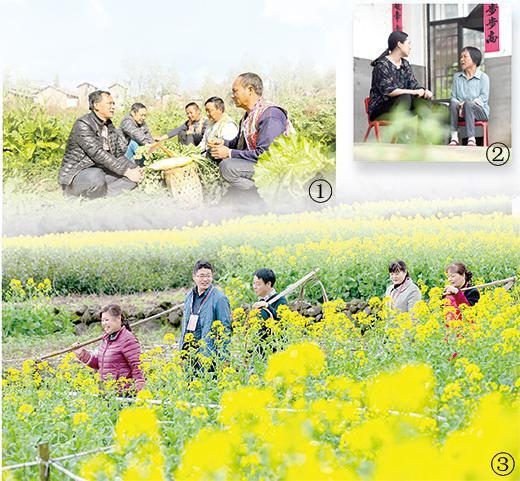
Figure ①: The cadres of the Discipline Inspection Commission of Longhai Township, luliang county, Qujing City, Yunnan Province conducted in-depth visits and investigations. Wang Yongshe (people’s vision) Figure 2: Wang Lian (left), director of Gongshan Village, Yuexi County, Anqing City, Anhui Province, communicates with the villagers. Xinhua News Agency reporter Zhou Mushe Figure 3: Cadres from Chun ‘an County, Hangzhou City, Zhejiang Province visited farmers to understand the implementation of the policy of benefiting farmers. Photo by Mao Yongfeng (People’s Vision)
Investigation and study are the basis of seeking something and the way to accomplish it. Paying attention to investigation and research is a fine tradition of our party.
The General Secretary of the Supreme Leader stressed that it is necessary to vigorously carry out investigation and research in the whole party. In October 2020, General Secretary of the Supreme Leader delivered an important speech at the opening ceremony of the training course for young and middle-aged cadres in the autumn semester of the Central Party School (National School of Administration), stressing that investigation and research are the basic skills for doing a good job. We must learn to investigate and study, and improve our working skills in investigation and study. Investigation and research should be regular.
New era, new mission. In the face of new problems in development and new challenges on the road to reform, how to do a good job of investigation and study and find a scientific solution? We interviewed some party member, cadres and experts.
Inherit the tradition and play the "first move"
The unity of subjectivity and objectivity, theory and practice is the consistent principle of our party. Carrying out investigation and research is an important part of it. The proposal of major strategies and the introduction of major decisions are inseparable from in-depth research and scientific research.
Paying attention to investigation and research is an important heirloom for our party to do a good job in leadership in various historical periods of revolution, construction and reform. Since the 18th National Congress of the Communist Party of China, the CPC Central Committee with the Supreme Leader as the core has taken in-depth investigation and study as the "first move" to carry out work, introduce policies and formulate strategies. "Now, the whole party inherits the party’s fine traditions and attaches great importance to investigation and research, which has become an opportunity for us to carry out our work scientifically and constantly overcome difficulties ‘ Golden key ’ 。” Xie Chengxin, vice president of the Hunan Provincial Party History Research Institute, said.
To carry out investigation and study, in order to be solid and in-depth, we must exert ourselves with heart and affection. It’s hard to gain anything if you don’t jump down and sink to the front line and see and experience it yourself.
For Zhu Yegan, investigation and research is a basic skill. As the deputy director of the Comprehensive Research Office of the General Office of Anhui Provincial Party Committee, one of Zhu Yegan’s duties is to carry out investigation and research to provide reference for decision-making. What impressed him the most was a survey on "Anhui province implementing the national strategy of integrated development of the Yangtze River Delta".
"Yangtze River Delta Integration" is a national strategy. How should Anhui integrate better? The policy research department of Anhui Provincial Party Committee dispatched a special person to form a research group, and conducted separate research inside and outside the province. The first thing to do is desk work, and Zhu Yegan "caught all the relevant information" and "chewed" it all over. Secondly, the choice of research points. "The Yangtze River Delta is integrated and Shanghai is the leader, so our research points outside the province are selected in Shanghai." Zhu Yegan said that it is necessary to find Anhui’s comparative advantages through research, and then optimize the layout of the industrial chain and create an innovation platform.
Go to the scene and find ideas. "We talked face to face with the cadres of the Yangtze River Delta Regional Cooperation Office, the Political Research Office of the Shanghai Municipal Committee, the Lingang Group and other units, and many sparks of thinking collided; Go deep into the park, visit enterprises, and go to Shanghai caohejing Emerging Technology Development Zone and Songjiang G60 Kechuang Cloud Gallery for field research. " Zhu Yegan introduced that on the way to Songjiang New Town, a 1.5-kilometer building complex in Fiona Fang came into their eyes, with a cloud-like roof and ups and downs. "So this is Songjiang G60 Kechuang Cloud Gallery!" Going in, all kinds of new industries and innovations have opened our eyes and inspired many new development ideas … …
"Through investigation, we have a deeper understanding of innovation, and thus put forward suggestions for building a scientific and technological innovation circle in the Yangtze River Delta and promoting innovation synergy in a wider scope." Zhu Yegan introduced that this research proposal is also in line with the relevant contents of the Outline of the Yangtze River Delta Regional Integration Development Plan released by the central government.
Based on the current situation in the province and the experience of research outside the province, the research team polished more than a dozen comprehensive research reports and special reports on industrial development and innovation synergy, which provided reference for relevant decisions in the province.
It is a practical and effective working method to carry out investigation and research around the center and serve the overall situation. How can the central policy be implemented at the local level? Will the documents formulated by the province be "acclimatized" at the grassroots level? Can the good practices in one place be promoted on a wider scale? To answer these questions, in-depth research is the only way.
Yang ziyong, director of the second division of the reform office of Hunan provincial party Committee, once served as the captain of the poverty alleviation work in the village in Fenghuang county, Xiangxi. How to realize rural revitalization after poverty alleviation in rural areas? What talents do you need to support the industry? This is what Yang Ziyong and his colleagues have been thinking about for a while.
In order to find the answer, they went to Fenghuang County to investigate. Everyone enters the village and enters the household, asking carefully and recording carefully. The survey found that although Fenghuang County did not get rid of poverty for a long time, some characteristic industries in villages and towns developed very well. This has a lot to do with the local emphasis on using young, highly educated and thoughtful village cadres.
Seeing the changes in rural areas and farmers with their own eyes, Yang Ziyong and his colleagues realized the important role of talents in rural revitalization. The investigation formed a special report to provide reference for the relevant decision-making of Hunan Provincial Party Committee. "Next, we will conduct more research on rural revitalization from multiple angles and aspects to provide more help for expanding policy supply." Yang Ziyong said.
For leading cadres at all levels, in order to improve the scientific level of decision-making, investigation and research must run through the whole process of decision-making. "For the issues related to the overall situation of reform, development and stability in this region and this department, we should insist on not making decisions without investigation, and making decisions after investigation." Xie Chengxin pointed out that it is necessary to uphold and improve the research work system of leading organs and leading cadres, and promote the regularization and normalization of research.
Make friends with the masses and be a good "pupil" of the masses.
Carrying out investigation and research is an important way to keep close contact with the masses. Good investigation and study must come from the masses and go to the masses.
In 1930, during the investigation in Xunwu County, Comrade Mao Zedong directly held an investigation meeting with people from all walks of life, and mastered a large number of first-hand materials, such as the output and price of various products in the county, the number and proportion of people from all walks of life in the county, the varieties and income of various shops, the amount of land and income distributed by farmers everywhere, and the political attitudes of all kinds of people. This in-depth, pragmatic style has set a benchmark and example for the investigation of cadres in party member.
How can investigation and research achieve practical results? We must put down our airs and dive down, go deep into the fields and factories and mines, discuss problems with the masses, listen to their voices, observe their emotions, feel their sufferings, sum up their experience and absorb their wisdom.
"Make friends with the masses, and be a good one ‘ Pupils ’ In this way, we can find the real problem and touch the real situation. " Yuan Naiyu, executive deputy director of the Organization Department of Yaohai District Committee of Hefei City, Anhui Province, said, "If the grass-roots investigation is not done properly, it will easily become superficial. If you want to know what the masses think, you must integrate into the masses. "
Once, Yuan Naiyu and his colleagues, as volunteers, went to Dingyuan Mansion Community in Fanchang Road, Yaohai District to participate in the community cleaning. With half a bucket of water at their feet and a rag in their hands, the way they tried to clean the glass attracted the praise of the residents, and Yuan Naiyu took the opportunity to talk to everyone.
"Old man, how do you feel living here? Is there any inconvenience? " "What all good, is the lack of an activity place. There are many elderly people in the community, and many people like to sing and dance. The venue is easy to find when it is sunny, and it is inconvenient when it is windy and rainy! "
I found the needs of residents at once, and also had the topic of further investigation. Around this issue, they visited many communities and held symposiums to listen to the opinions of residents. Soon, Fanchang Road Community built a party-mass service station in Dingyuan Mansion. In addition to vocal music, dance and calligraphy, there is also a "3: 30 class" to meet the needs of young parents. Up to now, Yaohai District has established 115 "neighbors" party and mass service stations.
After long-term research at the grassroots level, Yuan Naiyu has worked out a set of his own research methods: defining the purpose of research, classifying and layering, combining points and areas, creating a good research environment and establishing a feedback mechanism. "After the investigation, it is necessary to exchange, compare and repeat the work, systematize the scattered knowledge and deepen the superficial understanding until we find the essential law of things and find the correct way to solve the problem. Sometimes it even takes many investigations to get closer to the truth. " Yuan Naiyu said.
Good research can get twice the result with half the effort. "After the investigation, if you can’t finish the report, you should put it on the shelf. It is necessary to strengthen the application of the results, let in-depth research guide scientific decision-making, and promote new progress and breakthroughs in the work." Zhu Guiping, director of the Academic and Editorial Committee of the Anhui Provincial Party History Research Institute, said.
People’s Daily (19th edition, March 23rd, 2021)